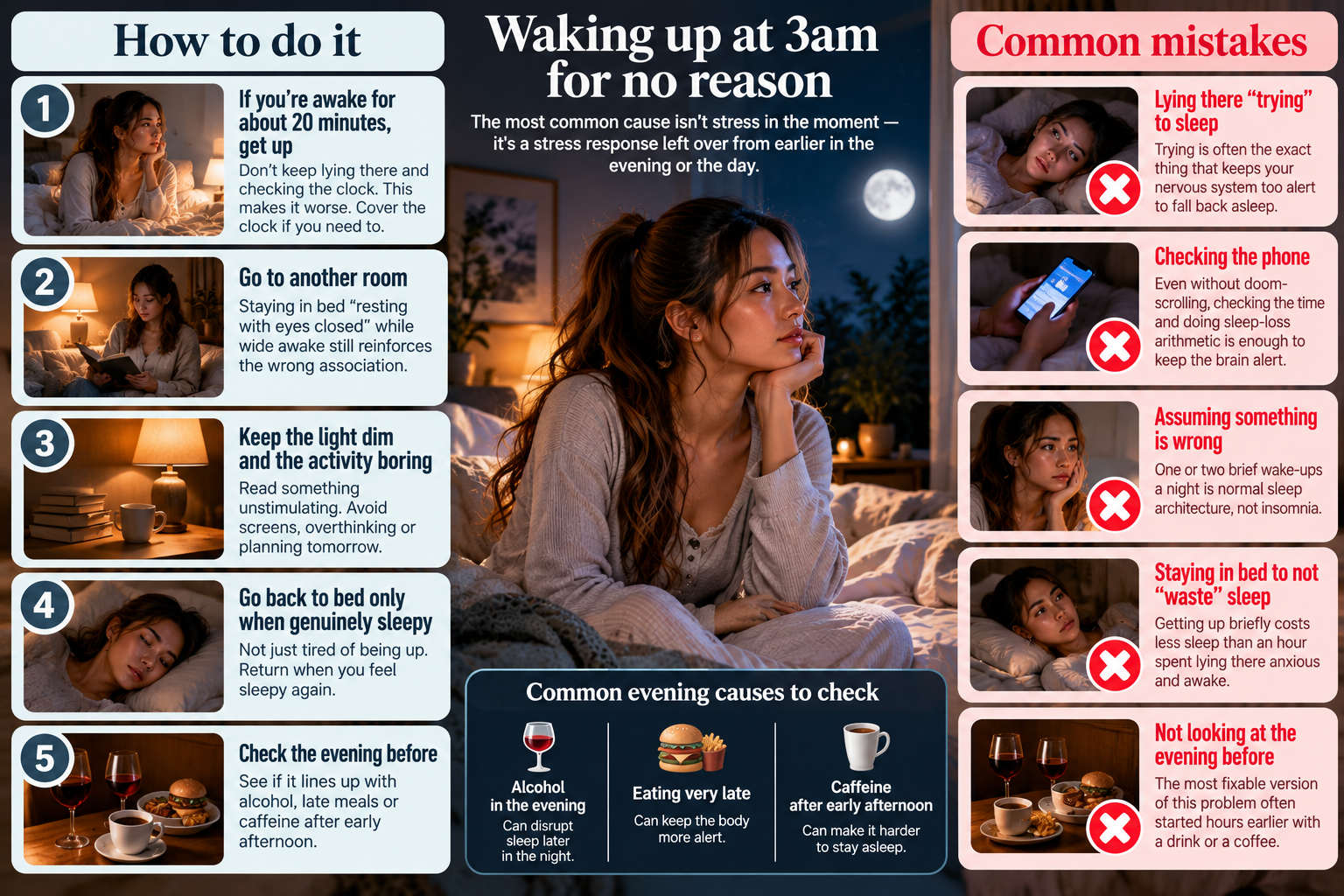
Waking up at 3am for no reason
The most common cause isn't stress in the moment — it's a stress response left over from earlier in the evening or the day.

Before you try this. Waking gasping, choking, or with a racing heart and chest pain is not what this article covers — that pattern warrants a conversation with a doctor about sleep apnoea or a cardiac cause rather than a behavioural fix.
One mindvestment
Get out of bed after 20 minutes awake rather than lying there trying to force sleep
- Costs
- 0 min a day
- Effort
- Medium
- Gives you
- Fewer and shorter middle-of-the-night wake-ups over 2–3 weeks
- Felt after
- 2–3 weeks
If you wake and cannot get back to sleep within about twenty minutes, get up. Go to another room, keep the lights low, and do something quiet and non-stimulating until you feel sleepy again, then go back to bed.
Why this works
A 3am wake-up usually isn’t caused by anything happening at 3am. Sleep runs in cycles of roughly 90 minutes, alternating between lighter and deeper stages, and the early hours of the morning are where lighter stages and REM sleep dominate — which is simply when a person is most easily woken by anything: a noise, needing the bathroom, a slightly too-warm room, or nothing identifiable at all. The wake-up itself is normal. What turns it into a problem is what happens in the ten minutes after.
Lying in bed, awake, starting to worry about being awake, checking the time, doing the math on how much sleep is left — that response trains the brain to associate the bed with wakefulness and anxious alertness rather than sleep. This is the mechanism behind one of the best-supported tools in sleep medicine, stimulus control: if the bed stops reliably predicting sleep, get out of it until it does again, rather than reinforcing the wrong association night after night.
There’s also frequently an earlier cause worth checking rather than a mysterious one. Alcohol in the evening reliably produces a rebound in arousal in the second half of the night. A late, large meal can do something similar. And caffeine’s six-hour half-life means an afternoon coffee is sometimes still partly active at 3am, thinning out the deeper sleep stages that would otherwise carry a person through.
How to do it
- If you’re awake and alert after roughly twenty minutes, get up rather than continuing to lie there. Checking the clock repeatedly makes this worse, not better — cover it if you need to.
- Go to another room if you can. Staying in bed “resting with eyes closed” while wide awake still reinforces the wrong association.
- Keep the light dim and the activity boring on purpose. Reading something unstimulating works. A screen, an argument in your head, or planning tomorrow does not.
- Go back to bed only once you feel genuinely sleepy again, not just tired of being up.
- Rule out the obvious causes first: check whether it lines up with evenings you drank alcohol, ate very late, or had caffeine after early afternoon.
Common mistakes
- Lying there “trying” to sleep. Trying is often the exact thing that keeps the nervous system too alert to fall back asleep.
- Checking the phone. Even without doom-scrolling, checking the time and doing sleep-loss arithmetic is enough to keep the brain alert.
- Treating every wake-up as a sign something is wrong. One or two brief wake-ups a night is normal sleep architecture, not insomnia.
- Staying in bed out of a fear of “wasting” the chance to sleep. Getting up briefly costs less sleep than an hour spent lying there anxious and awake.
- Not looking at the evening before. The most fixable version of this problem often started six hours earlier with a drink or a coffee.
What should change
Expect fewer wake-ups, and shorter ones when they happen, over two to three weeks of consistently getting up rather than lying there. This is a retraining process, not an instant fix — the first week can feel like more effort for no visible reward, which is normal and not a sign it isn’t working.
Your next step
If evening alcohol or a late caffeine cut-off line up with the bad nights, those are usually a faster win than the getting-up technique alone — fix the cause where there is one, and use this as the response for the nights that happen anyway.
Sources (2)
- Cortisol awakening response and middle-of-the-night awakenings Psychoneuroendocrinology 2015
- Stimulus control therapy for insomnia, efficacy review Sleep Medicine Reviews 2017