Move your caffeine cut-off to 2pm
Half of an afternoon coffee is still in you at bedtime, and it costs you sleep even on nights you fall asleep fine.

Before you try this. Cutting caffeine quickly gives most regular drinkers a headache and low mood for two to four days. Move the cut-off an hour earlier every few days instead of all at once.
One mindvestment
Take your last caffeine of the day before 2pm
- Costs
- 0 min a day
- Effort
- Medium
- Gives you
- Falling asleep faster, more deep sleep, fewer wake-ups
- Felt after
- 3–10 days
Take your last caffeinated drink before 2pm and hold that for two weeks. Not less caffeine — just earlier.
Why this works
Caffeine has a half-life of roughly five to six hours in most adults. A 4pm double espresso means a meaningful share of that dose is still circulating at midnight. It does not need to keep you awake to cost you something.
That is the part most people miss. Caffeine blocks adenosine, the molecule that builds up through the day and creates sleep pressure. You can fall asleep on top of it and still get shallower sleep, less slow-wave sleep, and more brief awakenings you never remember. The night feels normal. The next afternoon does not, so you have another coffee, and the loop closes.
Individual variation here is real and large. A common variant in the CYP1A2 gene roughly separates fast metabolisers from slow ones, and slow metabolisers can be affected by an espresso eight hours later. This is why “coffee never affects me” and “one cup ruins my night” are both true statements about different people. You find out which you are by testing, not by reasoning.
How to do it
- Write down what you actually have for three days, including tea, energy drinks, pre-workout and dark chocolate late in the evening.
- Find your current last dose. Move it one hour earlier every third day until it sits before 2pm.
- Keep the total the same at first. Only change the timing. Change one thing and you can read the result.
- Hold it for two weeks before deciding anything.
- If you want the afternoon drink as a ritual, keep the ritual and drop the caffeine. Decaf is not a compromise here, it is the whole point — the ritual was never the stimulant.
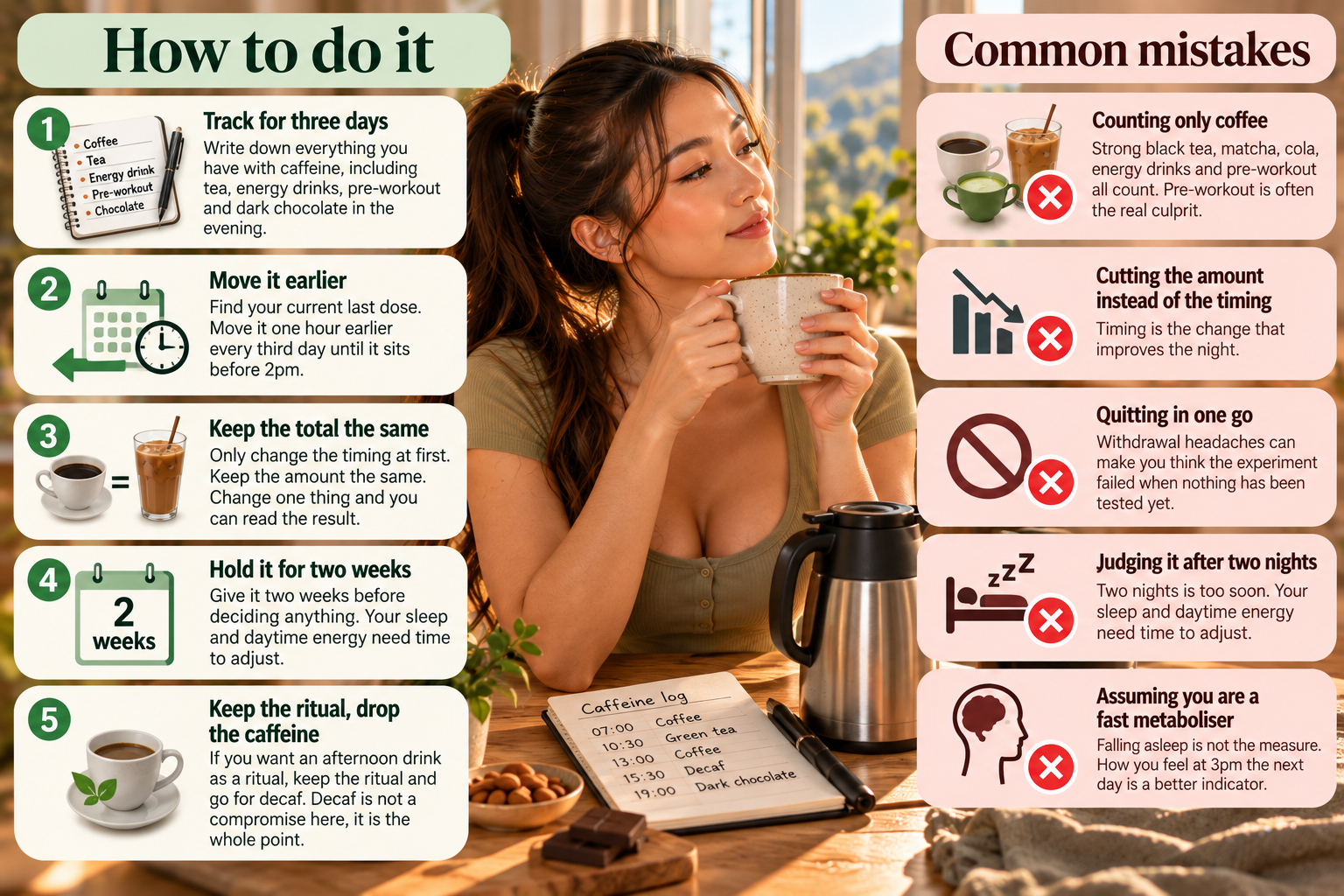
Common mistakes
- Counting only coffee. Strong black tea, matcha, cola, energy drinks and pre-workout all count. Pre-workout is frequently the real culprit in someone who trains at six in the evening.
- Cutting the amount instead of the timing. Timing is the change that improves the night.
- Quitting in one go. Withdrawal headaches convince people the experiment failed when nothing has been tested yet.
- Judging it after two nights. If you have been short on sleep for months, the first few nights of better sleep can feel worse, not better.
- Assuming you are a fast metaboliser because you sleep fine. Falling asleep is not the measure. How you feel at 3pm the next day is closer to it.
What should change
Expect to fall asleep faster and wake fewer times in the night. If you track sleep, deep sleep in the first half of the night is the number most likely to move. If nothing changes after two weeks, you are probably a fast metaboliser and this is not your lever — go back to wake time and morning light.
Your next step
If the nights improve but the twenty minutes before bed are still noisy, that is a separate problem with a separate fix.
Sources (2)
- Caffeine effects on sleep taken 0, 3 and 6 hours before going to bed Journal of Clinical Sleep Medicine 2013
- Genetic variation in CYP1A2 and caffeine metabolism Pharmacogenetics and Genomics 2016