Wake up at the same time every day
The single change your body clock responds to more than any other — and the one most people break every weekend.

One mindvestment
Get up within the same 30-minute window every day, including weekends
- Costs
- 0 min a day
- Effort
- Medium
- Gives you
- Faster sleep onset, less grogginess, morning light and caffeine timing both work better
- Felt after
- 1–3 weeks
Pick a wake time and hold it within about thirty minutes, seven days a week. Not a bedtime — a wake time. This is the one change almost everything else on this site depends on.
Why this works
Bedtime is a bad lever because it is downstream of things you cannot control on a given night — how the day went, how tired you actually are. Wake time is upstream. It is the one anchor point your circadian clock can reliably use, because it is the moment your morning light and your first caffeine both happen, and both of those in turn set the following night.
A useful way to think about it: a weekend that starts two hours later than the week is not rest, it is a two-hour flight to a new time zone, taken every Friday and reversed every Monday. Researchers call the resulting mismatch social jetlag, and cohort data links it independently to worse sleep, lower mood and higher weight — not because staying up late is inherently bad, but because the shifting itself is what the clock struggles with.
This is also why “I’ll catch up on sleep this weekend” mostly fails at its actual goal. It reduces the sleep debt for a day or two and then re-creates it by making Sunday night harder to fall asleep in.
How to do it
- Work out the wake time your week actually needs — not the one you wish you had. Be honest about your earliest required day.
- Set that as every day’s wake time, weekends included, for three weeks before judging it.
- Get out of bed within a few minutes of the alarm. Lying in a doze for forty minutes is not the same as sleeping and does not help the clock.
- Pair it immediately with outdoor light — the two changes reinforce each other and are much weaker done alone.
- If you are badly sleep-deprived, allow one lie-in of up to an hour, not three or four. A short lie-in is a repair. A long one is a reset in the wrong direction.
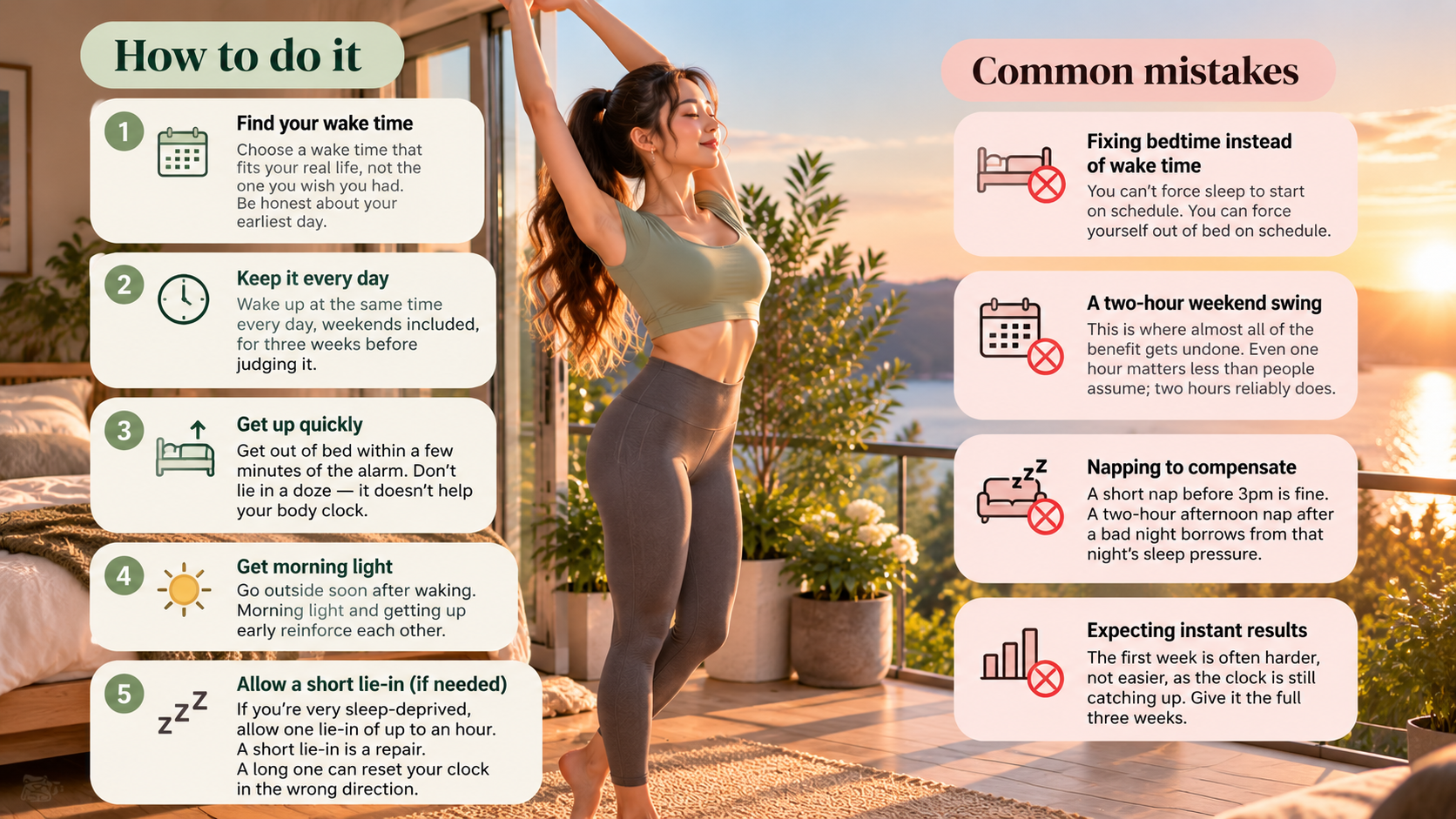
Common mistakes
- Fixing bedtime instead of wake time. You cannot force sleep to start on schedule. You can force yourself out of bed on schedule.
- A two-hour weekend swing. This is where almost all of the benefit gets undone. Even one hour matters less than people assume; two hours reliably does.
- Napping to compensate. A short nap before 3pm is fine. A two-hour afternoon nap after a bad night borrows directly from that night’s sleep pressure.
- Expecting instant results. The first week is often harder, not easier, as the clock is still catching up. Give it the full three weeks.
What should change
Falling asleep should get easier and more predictable within two to three weeks, and grogginess on waking should fade. If it does not move at all, check whether your actual wake time is still drifting on weekends — this is the most common reason the change appears not to work.
Your next step
Once wake time is steady, morning light does the rest of the work almost automatically — it becomes the thing you do the moment you get up, rather than a separate decision.
Sources (2)
- Social jetlag and its association with weight, sleep and mood Current Biology 2012
- Sleep regularity index as a predictor of health outcomes, large cohort study Sleep 2021