Cool the room down
Your core temperature has to drop for sleep to start — a warm bedroom fights that directly, and it is one of the cheapest fixes on this site.

One mindvestment
Set the bedroom to around 18°C (65°F), or as close to it as your setup allows
- Costs
- 0 min a day
- Effort
- Low
- Gives you
- Faster sleep onset, fewer night wake-ups, deeper sleep
- Felt after
- Immediate, first night
Set the bedroom to around 18°C, roughly 65°F, or as close as your situation allows. This is one of the few changes here with an effect you can feel on the very first night.
Why this works
Falling asleep is partly a temperature event. Your core body temperature needs to drop by around half a degree to a degree for sleep onset to happen, and your body manages this mainly by dilating blood vessels in the hands and feet to dump heat — which is why they often warm up right before you doze off.
A hot bedroom works directly against this. It is harder for the body to shed heat into warm air, so the temperature drop is slower and shallower, sleep onset takes longer, and the deep, slow-wave sleep concentrated in the first part of the night is particularly sensitive to it. A room that is too cold has the opposite problem, keeping you in light sleep as you curl up to conserve heat, so this is a real target range rather than “colder is always better.”
How to do it
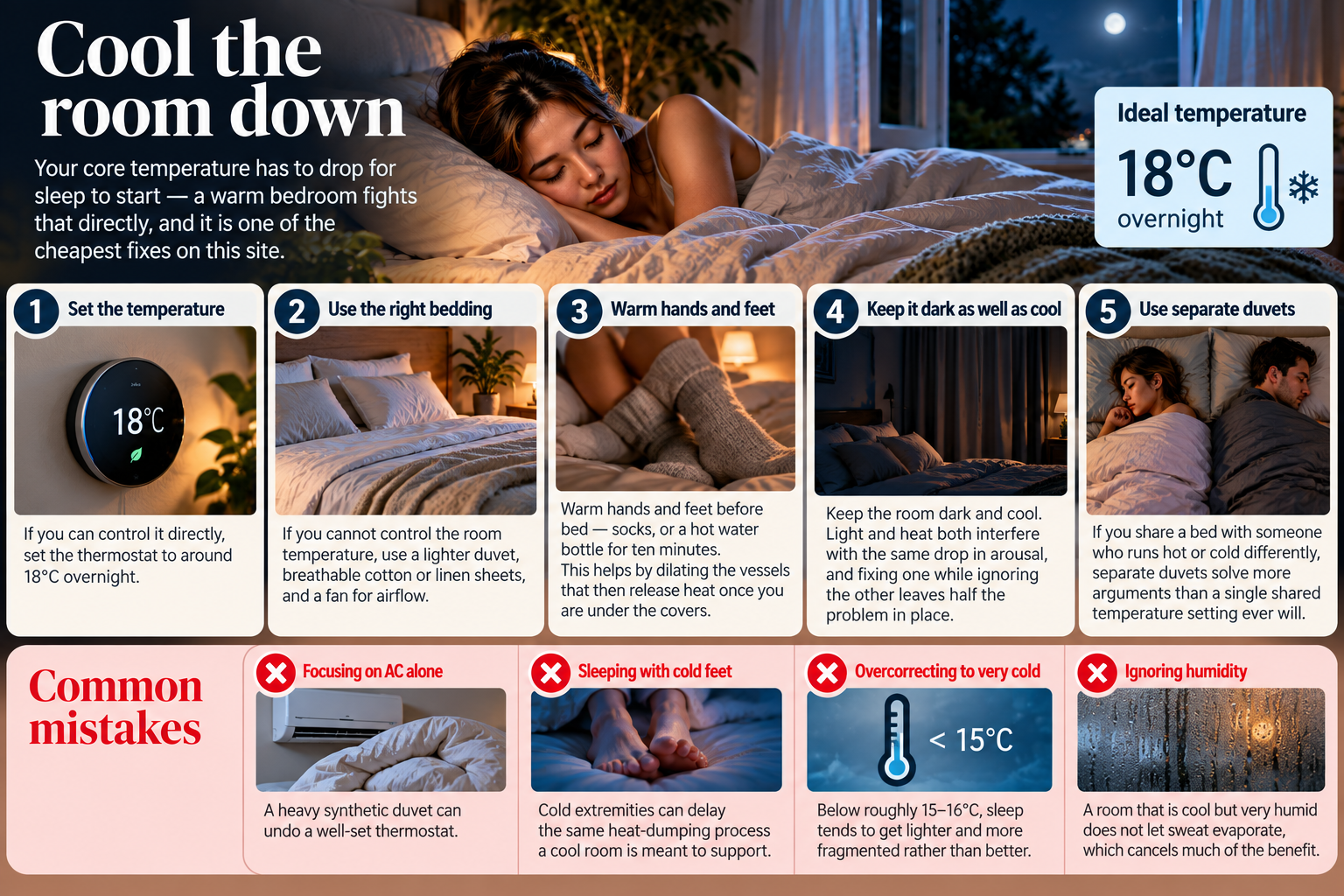
- If you can control it directly, set the thermostat to around 18°C overnight.
- If you cannot control room temperature, control your temperature: a lighter duvet, breathable cotton or linen sheets, and a fan for airflow do a meaningful share of the same job.
- Warm hands and feet before bed — socks, or a hot water bottle for ten minutes — sounds contradictory but helps, because it dilates the vessels that then release heat once you are under the covers.
- Keep the room dark as well as cool. Light and heat both interfere with the same drop in arousal, and fixing one while ignoring the other leaves half the problem in place.
- If you share a bed with someone who runs hot or cold differently, separate duvets solve more arguments than a single shared temperature setting ever will.
Common mistakes
- Focusing on air conditioning alone and ignoring bedding. A heavy synthetic duvet can undo a well-set thermostat.
- Sleeping with cold feet. Cold extremities can delay the same heat-dumping process a cool room is meant to support.
- Overcorrecting to very cold. Below roughly 15–16°C, sleep tends to get lighter and more fragmented rather than better.
- Ignoring humidity. A room that is cool but very humid does not let sweat evaporate, which cancels much of the benefit.
What should change
This is one of the fastest-acting changes on the site. Expect a difference the first or second night, mainly in how quickly you fall asleep and how deep the first few hours feel.
Your next step
Temperature and light work on the same mechanism from different angles. If the room is already cool and dark and sleep is still difficult, look at what is happening in the hour before bed instead.
Sources (2)
- Thermoregulation as a sleep signalling mechanism Sleep Medicine Reviews 2012
- Ambient bedroom temperature and polysomnographic sleep in adults Journal of Physiological Anthropology 2019