Ten slow minutes on the floor before bed
A short, boring sequence that lowers arousal before sleep — for the nights when your body is tired but your head is not.
Before you try this. Skip or modify anything that produces sharp pain, and avoid deep forward folds if you have disc problems. If you are pregnant, work from a version designed for that.
One mindvestment
Ten minutes of slow floor-based stretching before bed, with the phone in another room
- Costs
- 10 min a day
- Effort
- Low
- Gives you
- Falling asleep faster, less lying awake with a racing head
- Felt after
- 3–14 days
Ten minutes of slow, unambitious stretching on the floor, breathing out longer than you breathe in, phone in another room. Follow the sequence below.
Why this works
Falling asleep is not a decision. It happens when arousal drops far enough, and the thing that usually keeps it high is not the body but a nervous system that has had no transition between the day and the bed.
Two mechanisms are doing most of the work here, and neither of them is the stretching itself. The first is breathing: a longer exhale than inhale raises vagal tone and lowers heart rate within a couple of minutes. The second is simply having a reliable signal that the day is closing — a repeated cue the brain learns to read.
This is graded B rather than A on purpose. The trials on yoga and sleep are mostly small, rarely blinded, and hard to separate from the effect of any calm routine. The direction of the evidence is consistent and the risk is close to zero, which is enough to recommend it. It is not enough to claim it beats a wind-down routine you already like.
The sequence
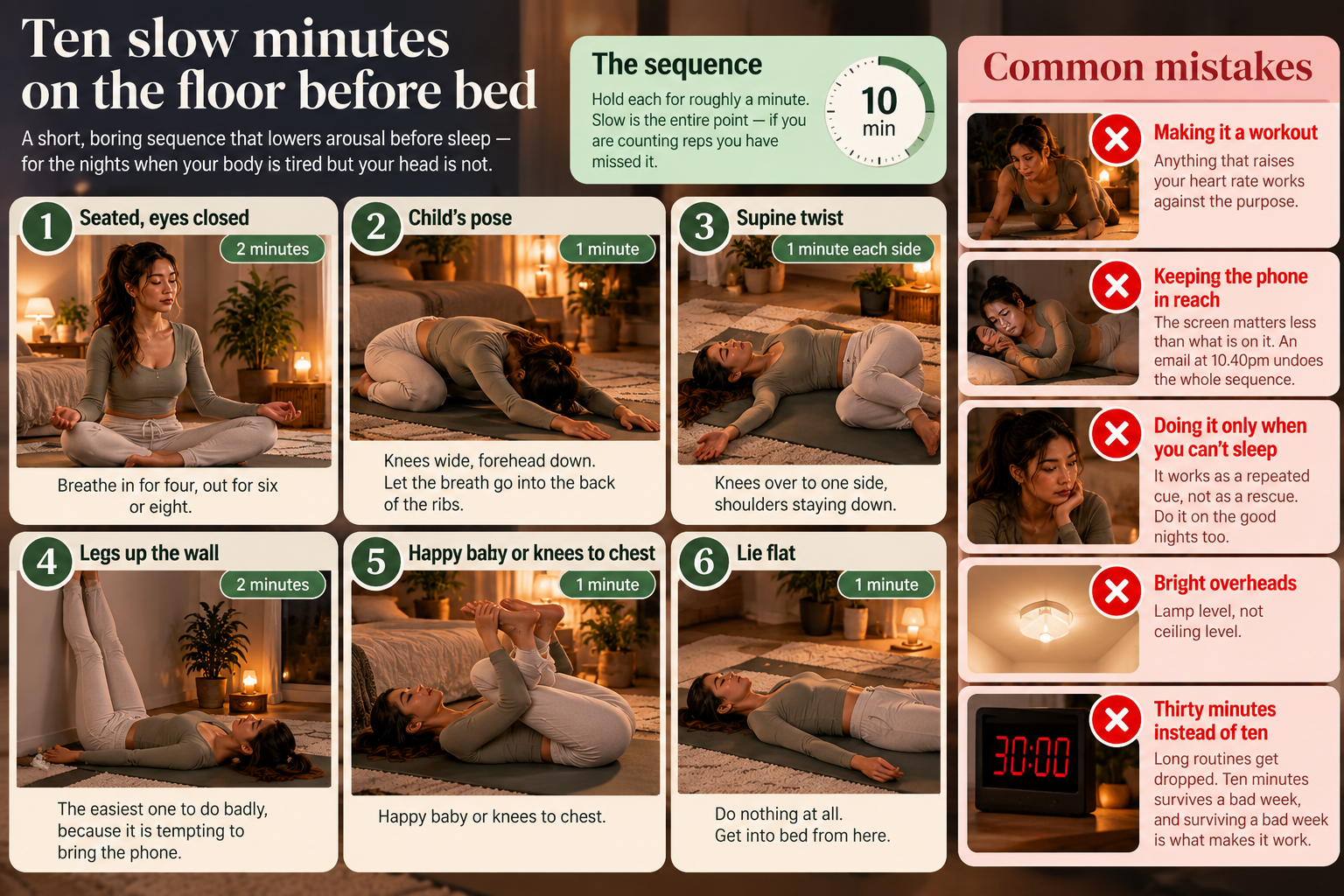
Hold each for roughly a minute. Slow is the entire point — if you are counting reps you have missed it.
- Seated, eyes closed. Breathe in for four, out for six or eight. Two minutes.
- Child’s pose. Knees wide, forehead down. Let the breath go into the back of the ribs.
- Supine twist, one minute each side. Knees over to one side, shoulders staying down.
- Legs up the wall. Two minutes. The easiest one to do badly, because it is tempting to bring the phone.
- Happy baby or knees to chest. One minute.
- Lie flat. One minute doing nothing at all. Get into bed from here.
Common mistakes
- Making it a workout. Anything that raises your heart rate works against the purpose.
- Keeping the phone in reach. The screen matters less than what is on it. An email at 10.40pm undoes the whole sequence.
- Doing it once when you cannot sleep. It works as a repeated cue, not as a rescue. Do it on the good nights too.
- Bright overheads. Lamp level, not ceiling level.
- Thirty minutes instead of ten. Long routines get dropped. Ten minutes survives a bad week, and surviving a bad week is what makes it work.
What should change
The gap between getting into bed and falling asleep should shorten over a week or two. If your head still races after that, caffeine timing is the thing to look at before anything else.
Your next step
If this becomes a habit, the version most worth adding is dimming the lights an hour before rather than adding more minutes on the floor.
Sources (2)
- Meditative movement and sleep quality in adults with insomnia symptoms Sleep Medicine Reviews 2019
- Slow breathing, vagal tone and pre-sleep arousal Frontiers in Human Neuroscience 2018