What alcohol actually does to your sleep
It can make you fall asleep faster and still leave you with a worse night — here is the mechanism and where the real trade-off sits.

Before you try this. If you drink heavily and are considering cutting back sharply, alcohol withdrawal can be medically serious. Talk to a doctor before stopping suddenly rather than doing it alone.
One mindvestment
Stop drinking at least 3 hours before bed, and treat any evening with more than one or two drinks as a night you will sleep worse
- Costs
- 0 min a day
- Effort
- Medium
- Gives you
- Less fragmented sleep, fewer early wake-ups, more REM sleep
- Felt after
- Immediate, per night
Stop drinking at least three hours before bed, and expect a worse night after any evening with more than one or two drinks, even if you fell asleep quickly.
Why this works
Alcohol is a sedative, which is exactly why it is confusing. It does genuinely help you fall asleep faster in the first hour or two. The problem is what happens after that.
As your body metabolises the alcohol over the night, it produces a rebound in nervous system arousal in the second half of sleep. This is when REM sleep, which is normally concentrated toward morning, gets suppressed and fragmented, and when the wake-ups tend to happen — the three-in-the-morning awakenings that feel unexplained are very often this. Alcohol is also a reliable trigger for snoring and airway relaxation, which matters more the closer to bedtime it is drunk.
The size of the effect scales with dose and with how close to bedtime you drink. A glass of wine with an early dinner and three hours to clear is a different night from the same glass at 11pm.
How to do it
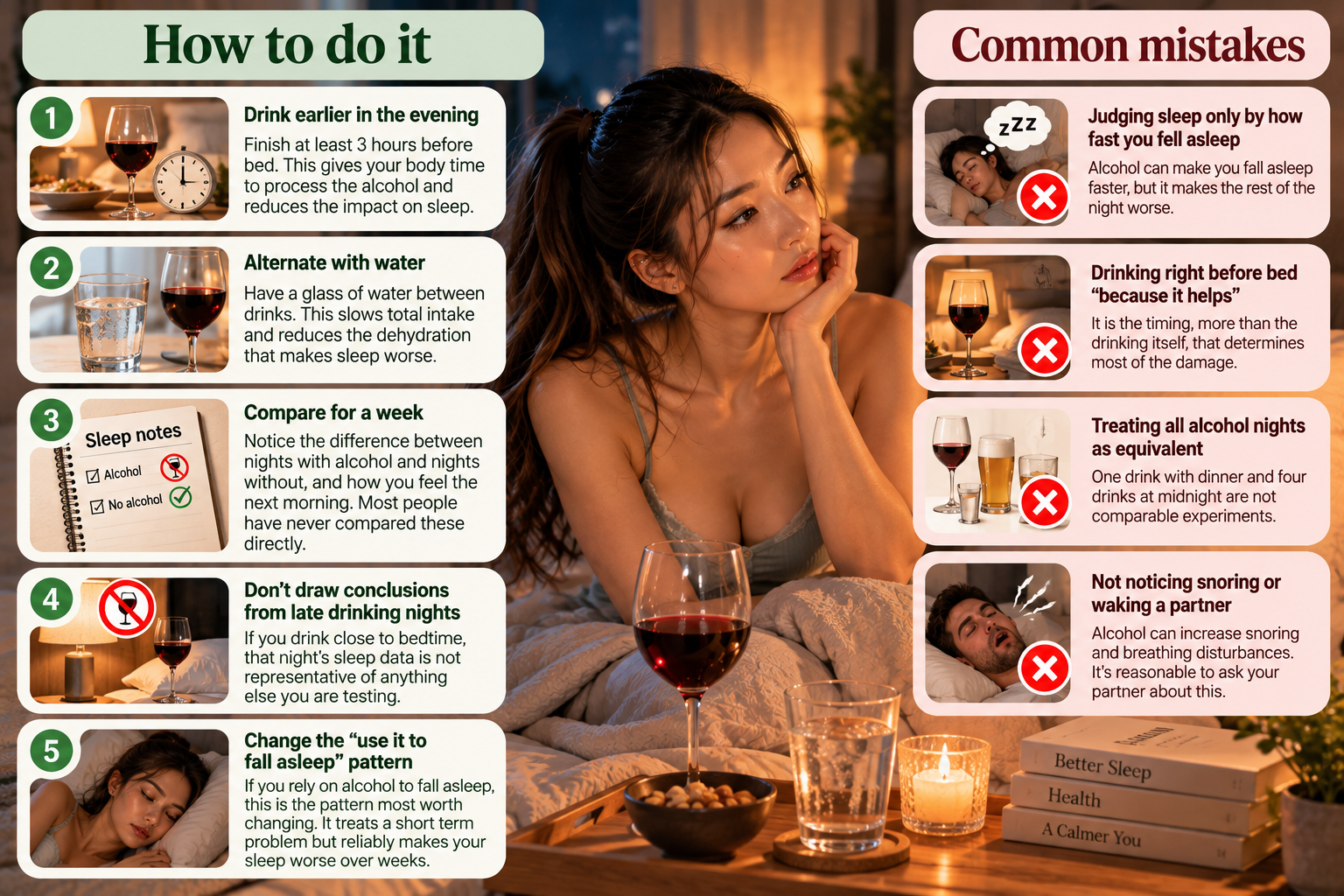
- If you are going to drink, do it earlier in the evening rather than right before bed. Three hours is a reasonable minimum to aim for.
- Alternate with water. This slows total intake and reduces the dehydration that compounds the sleep disruption.
- Notice the actual pattern for a week: nights with alcohol versus nights without, and how the following morning feels. Most people have never compared these directly.
- On nights you do drink close to bedtime, do not judge your sleep quality metrics from that night as representative of anything else you are trying.
- If you use alcohol specifically to fall asleep, that is the pattern most worth changing — it treats a night to night problem in a way that reliably makes the underlying sleep worse over weeks.
Common mistakes
- Judging sleep only by how fast you fell asleep. This is exactly the metric alcohol improves while making the rest of the night worse.
- Drinking right before bed “because it helps.” It is the timing, more than the drinking itself, that determines most of the damage.
- Treating all alcohol nights as equivalent. One drink with dinner and four drinks at midnight are not comparable experiments.
- Not noticing snoring or waking a partner. This is one of the most common and least discussed effects, and it is a reasonable thing to ask about directly.
What should change
On nights with no alcohol, or alcohol finished well before bed, expect fewer early-morning wake-ups and a night that feels more continuous. This is immediate and testable within a single week of comparison.
Your next step
If sleep is still fragmented on alcohol-free nights, caffeine timing is the next most common cause worth checking.
Sources (2)
- Alcohol and sleep, a systematic review of polysomnographic studies Alcoholism, Clinical and Experimental Research 2013
- Acute effects of alcohol on sleep architecture and the second half of the night Sleep Medicine Reviews 2018