Best stretches for a tight neck
A five-minute routine for ordinary neck tightness — the kind that builds up over a day of sitting — plus the signs that mean stretching is not the right tool.
Before you try this. This routine is for dull, generalised tightness only. Stop and seek medical advice instead of stretching if you have sharp or severe pain, pain radiating into an arm, numbness or weakness, significant dizziness, any new neurological symptom, a sudden severe headache, or symptoms that began after significant trauma.
One mindvestment
Five minutes of gentle neck and upper-back mobility, done daily rather than occasionally
- Costs
- 5 min a day
- Effort
- Low
- Gives you
- Less end-of-day neck tightness within days, easier head movement within 1–2 weeks
- Felt after
- 3–14 days
Five minutes, most days, slow and gentle throughout. This is for the ordinary tightness that accumulates over hours of sitting — not for sharp, radiating or persistent pain, which is a different problem with a different answer.
Why this works
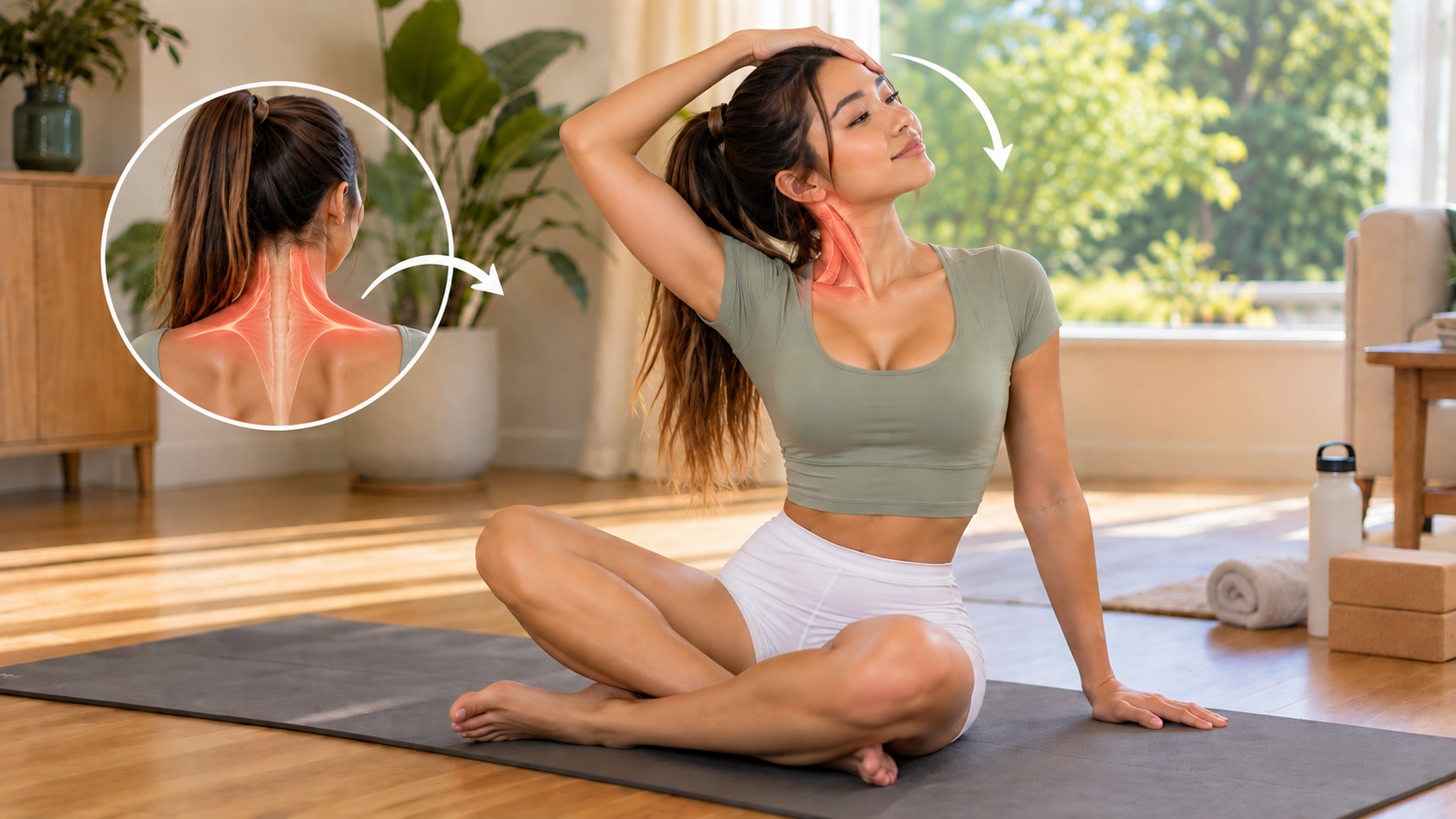
Most everyday neck tightness is not injury. It is a set of muscles — the upper trapezius, the levator scapulae running from neck to shoulder blade, the small muscles at the base of the skull — held in a low-level working position for hours, quietly stiffening as a result. A head that drifts forward of the shoulders, the default posture at a screen, increases the leverage demand on the muscles that support it, which can make sustained positions feel more demanding than they should. That sustained effort is part of what becomes the familiar ache.
Exercise for mechanical neck pain is one of the more-studied areas in musculoskeletal medicine, and the weight of the evidence points toward regular, appropriately dosed movement being more useful than occasional, forceful stretching. A Cochrane review of exercise for neck disorders is worth being precise about: it found no high-quality evidence overall, and minimal effect when only stretching was used — while strengthening work for the neck, shoulder and shoulder blade, and combinations of strengthening with endurance or stretching, had the better support. That is why the routine below is not just stretching: the chin tucks and shoulder blade squeezes add exactly the controlled strengthening and endurance work the evidence leans toward. The review does not prove that this specific six-exercise routine works, and no honest source could — it is built from individually supported movement types, combined into a short daily practice. This is graded B for that reason: a plausible, evidence-leaning approach with real limitations, not a validated protocol.
One thing the sequence below deliberately includes that pure neck stretching misses: the shoulders and upper back. Tightness in the neck is often partly generated below it — a chest and thoracic spine that have rounded forward all day drag the neck along with them, so a routine that only pulls at the neck itself tends to relieve it briefly and watch it return by mid-afternoon.
The sequence
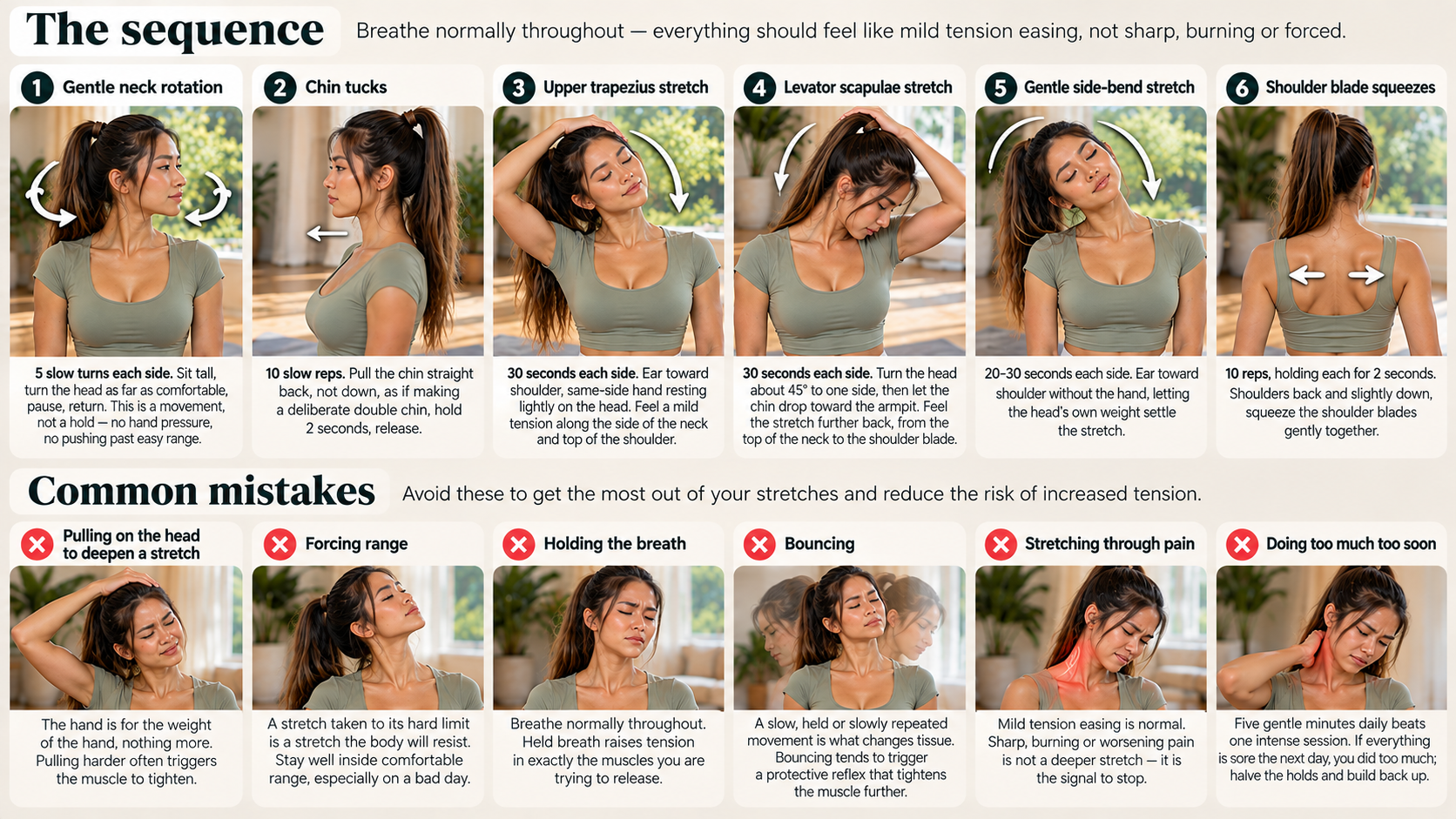
Breathe normally throughout — held breath tightens what you are trying to release. Everything should feel like mild tension easing. None of it should feel sharp, burning, or like something being forced.
-
Gentle neck rotation, 5 slow turns each side. Sit tall, turn the head to one side as far as is comfortable, pause, return. This is a movement, not a hold — no hand pressure, no pushing past the end of easy range.
-
Chin tucks, 10 slow reps. Pull the chin straight back, not down, as if making a deliberate double chin, hold 2 seconds, release. This strengthens the deep neck flexors at the front of the neck, the muscles that actually hold the head over the shoulders — the part most stretching routines skip entirely. You should feel a gentle working at the front and a lengthening at the base of the skull, not compression.
-
Upper trapezius stretch, 30 seconds each side. Ear toward shoulder, same-side hand resting lightly on the head for a little extra weight — resting, not pulling. You should feel a mild, comfortable tension along the side of the neck and top of the shoulder. If you feel tingling down the arm, ease off; that is a nerve, not a stretch.
-
Levator scapulae stretch, 30 seconds each side. Turn the head about 45 degrees to one side, then let the chin drop toward the armpit, same-side hand resting lightly as before. This targets the muscle that runs from the top of the neck to the shoulder blade, one of the areas that can feel particularly tight in a stiff neck — you will know you have the angle right because it will feel different from the trapezius stretch, slightly further back.
-
Gentle side-bend stretch, 20–30 seconds each side. Ear toward shoulder without the hand, simply letting the head’s own weight settle the stretch. A lighter, more relaxed version of step 3 to finish the neck itself.
-
Shoulder blade squeezes, 10 reps, holding each for 2 seconds. Shoulders back and slightly down, squeezing the shoulder blades gently together. This is the upper-back piece — it works the muscles that posture depends on rather than only stretching the ones that ache.
The whole sequence takes about five minutes. Daily beats occasional — a stretch mostly reverses today’s adaptation to today’s sitting, and does not bank for next week.
Common mistakes
- Pulling on the head to deepen a stretch. The hand on the head is for the weight of the hand, nothing more. Pulling harder mostly triggers the muscle to tighten defensively, which is the opposite of the point.
- Forcing range. A stretch taken to its hard limit is a stretch the body will resist. Stay well inside comfortable range, especially on a bad day.
- Holding the breath. Breathe normally throughout. Held breath raises tension in exactly the muscles you are trying to release.
- Bouncing. A slow, held or slowly repeated movement is what changes tissue. Bouncing tends to trigger a protective reflex that tightens the muscle further.
- Stretching through pain. Mild tension easing is normal. Sharp, burning or worsening pain is not a deeper stretch — it is the signal to stop.
- Doing too much too soon. Five gentle minutes daily beats one intense session. If everything is sore the next day, you did too much; halve the holds and build back up.
What should change
Expect the neck to feel a little freer immediately after each session, and less accumulated tightness by the end of the day within the first week. Within one to two weeks of daily practice, turning the head — reversing a car, checking a blind spot — should feel noticeably easier. This is maintenance, not a permanent fix: the tightness returns as long as the hours of sitting do, which is why the routine is built to be short enough to actually repeat.
If nothing has changed after three weeks of daily practice, or if anything sharp, radiating, numb, weak or dizzy shows up at any point, that is the moment to see a doctor or physiotherapist rather than stretch harder. Stretching addresses ordinary tightness well; it is not the tool for pain that behaves differently from that.
Your next step
If the tightness reliably builds up over the workday, the desk-work version of this problem — the chest and thoracic spine pulling the posture forward for hours at a stretch — is the underlying driver worth addressing next. A routine maintains; changing what the routine is compensating for is what actually reduces how much maintenance you need.
Sources (2)
- Neck and shoulder pain in office workers, a systematic review of exercise interventions Journal of Occupational Rehabilitation 2017
- Exercise for mechanical neck disorders, Cochrane review Cochrane Database of Systematic Reviews 2015