Five minutes for stiff hips
A short daily sequence for the tightness that comes from sitting most of the day, not from anything wrong with you.

Before you try this. Stop short of sharp or shooting pain — a stretch should feel like tension easing, not an injury forming. If you have had a hip replacement or a recent hip or back injury, check with a physiotherapist before starting.
One mindvestment
Five minutes of hip-opening stretches, done daily rather than occasionally
- Costs
- 5 min a day
- Effort
- Low
- Gives you
- Looser hips within days, less lower back tightness within a couple of weeks
- Felt after
- 3–14 days
Five minutes, most days, not a big session once a week. Follow the sequence below.
Why this works
Hip stiffness from a desk job is usually not a strength problem or a structural one. It is mostly the hip flexors — the muscles at the front of the hip — sitting in a shortened position for eight or more hours a day and adapting to that length. Adaptive shortening is quick to happen and, helpfully, quick to reverse with regular movement through range.
This is graded B rather than A for an honest reason: the trials on static stretching and mobility are real but mostly short-term, and “feeling looser” is measured more often than any functional outcome like reduced back pain. The direction of the evidence is consistent, the risk is close to zero, and five minutes is a small enough ask that it does not need A-grade certainty to be worth doing.
The reason five minutes daily beats twenty minutes weekly is not a training principle, it is simpler than that: a stretch mostly reverses today’s adaptation to today’s sitting. It does not bank for next week.
The sequence
Hold each side for 45–60 seconds. Breathe normally — held breath tightens rather than releases.
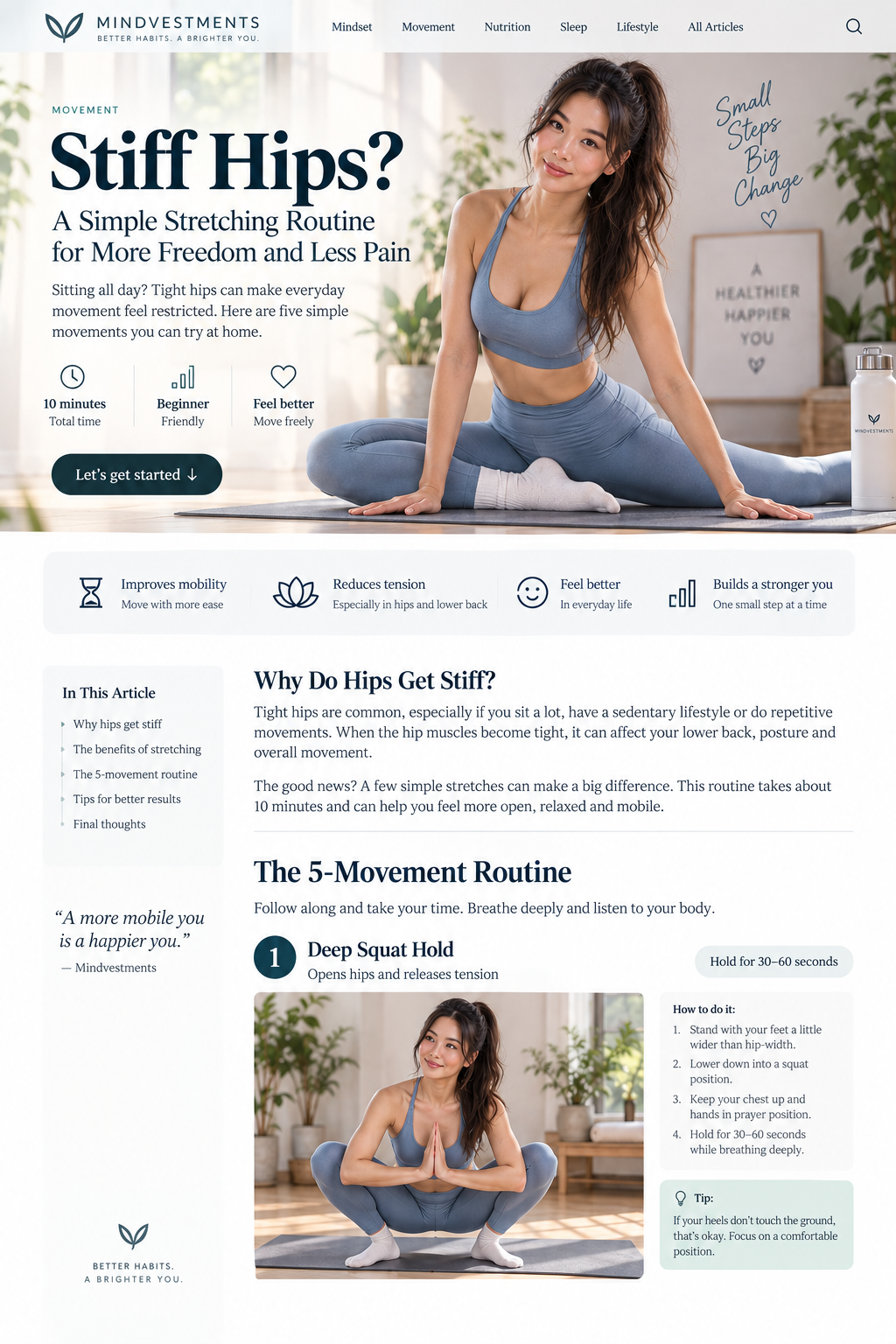
- Kneeling hip flexor stretch. One knee down, other foot forward, gently shift weight forward until you feel the front of the back hip.
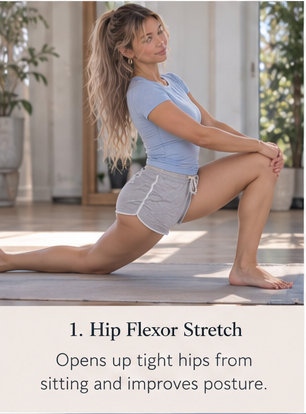
- Figure-four stretch, seated or lying down. Ankle crossed over the opposite knee, gently press the crossed knee away from you.
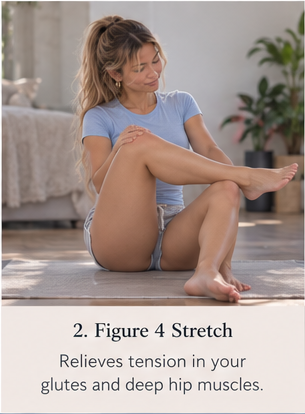
- Deep squat hold, heels down if you can, holding onto something for balance if needed. 30–60 seconds total.
- 90/90 hip stretch. Both legs bent at right angles, one in front and one to the side, lean gently forward over the front leg.
- Standing quad and hip flexor stretch, holding a wall for balance if needed.
Common mistakes
- Bouncing. A slow, held stretch is what changes tissue length. Bouncing mostly triggers a protective reflex that tightens the muscle further.
- Doing it once and expecting it to last. This is a maintenance habit, not a repair you do once.
- Only stretching, never moving through range. A short walk or a few bodyweight squats afterwards helps the new range actually get used.
- Ignoring the other hip. Most people are noticeably tighter on one side and only stretch the one that is talking to them.
- Ramping up flexibility fast. Small, daily progress beats a deep stretch you can only tolerate once a week.
What should change
Expect looser-feeling hips within days and less accompanying lower back tightness within one to two weeks, since a stiff hip often forces the lower back to move more than it should. If nothing changes after three weeks of daily practice, the tightness may be coming from somewhere else — worth mentioning to a physiotherapist rather than stretching harder.
Your next step
If sitting is the root cause, standing or moving for a few minutes every hour does more for hip stiffness over a week than any single stretch session — the two work best together, not as alternatives.
Sources (2)
- Static stretching and joint range of motion, systematic review Sports Medicine 2018
- Prolonged sitting and hip flexor shortening, an observational study Journal of Physical Therapy Science 2015