Neck and shoulder relief for desk work
A short routine for the tightness that builds up from hours of screen work, aimed at the actual cause rather than just the sore spot.

One mindvestment
Four minutes of neck, chest and upper-back mobility, done once or twice during the workday
- Costs
- 4 min a day
- Effort
- Low
- Gives you
- Less end-of-day tension, fewer tension headaches
- Felt after
- 1–2 weeks
Four minutes, once or twice through the workday. The routine below targets the front of the chest and the deep neck flexors as much as the neck itself, which is the part most people skip.
Why this works
The usual advice is to stretch the neck, and that helps a little, but it treats the symptom rather than the pattern. Hours forward at a screen shortens the chest muscles and lets the head drift forward of the shoulders, which forces the muscles at the base of the skull and across the upper trapezius to work far harder than they are built for, essentially holding the head up against gravity from the wrong angle. That constant low-level contraction is what becomes the ache, and it is also the most common mechanical contributor to tension headaches.
That is why a routine that only stretches the neck often provides short relief that returns by the afternoon: it never addresses the shortened chest that is pulling the posture forward in the first place. Working the chest open and strengthening the deep neck flexors, not just the visible neck muscles, is what actually changes the pattern rather than temporarily easing the symptom.
The sequence
- Doorway chest stretch, 30 seconds each arm position (low, mid, high on the frame).
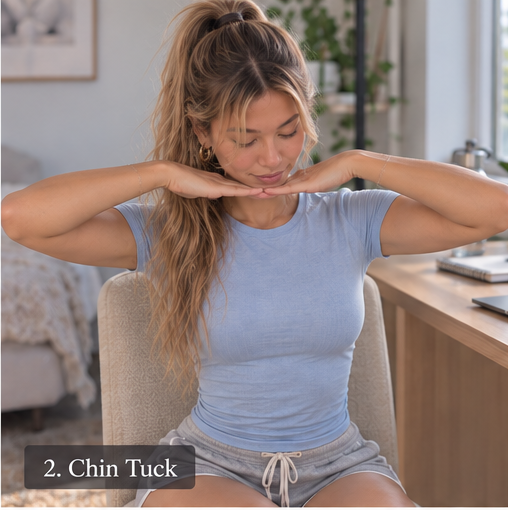
- Chin tucks, 10 slow reps — pull the chin straight back, not down, making a “double chin.” This strengthens the deep neck flexors that posture depends on.
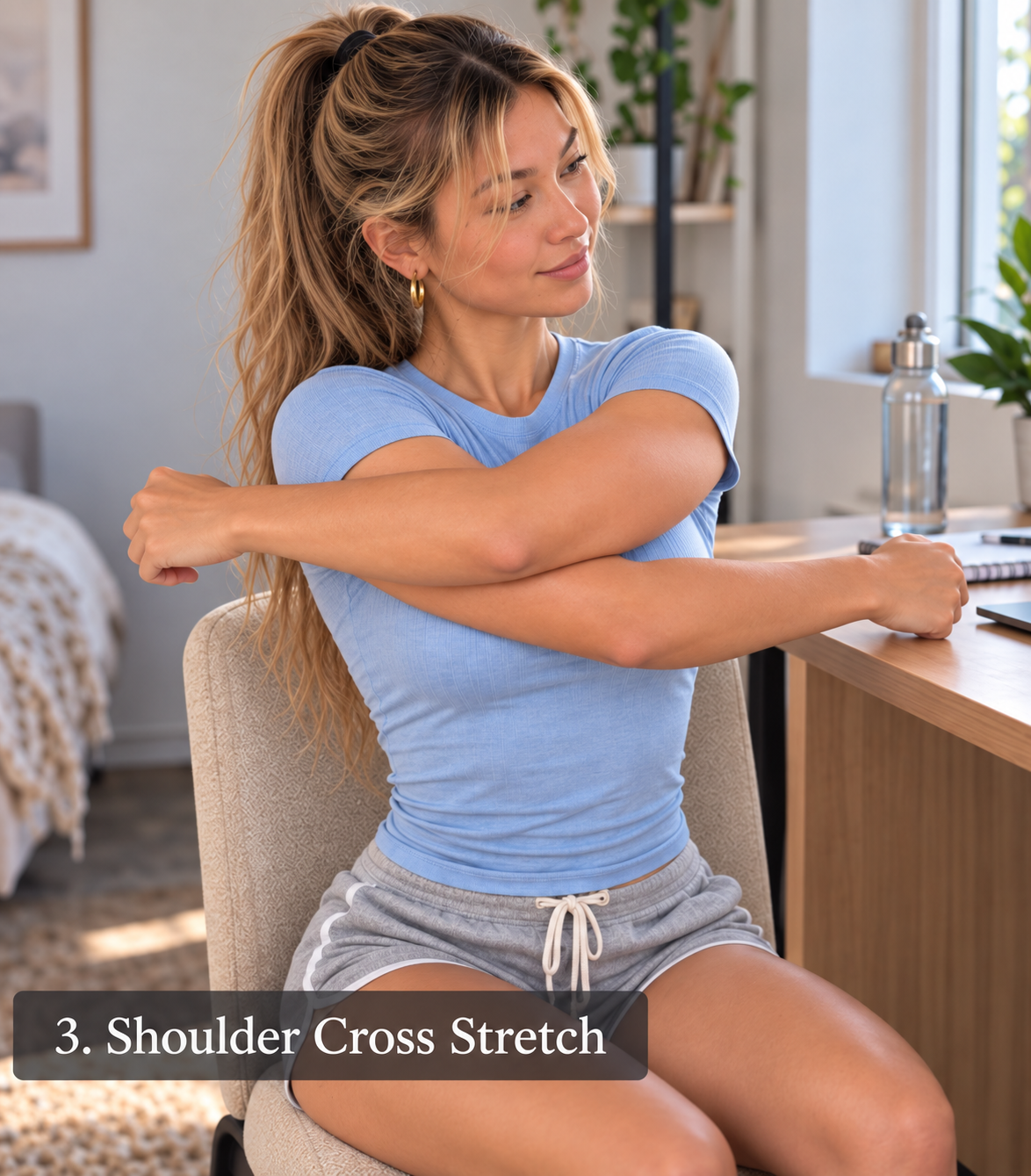
- Upper trapezius stretch, ear to shoulder, gentle hand pressure, 30 seconds each side.
- Thoracic extension over a chair back, hands behind head, gently arch over the chair for 5–8 slow reps.

- Shoulder blade squeezes, 10 reps, hold each for 2 seconds.

Common mistakes
- Only stretching the sore spot. The trapezius is usually the symptom, not the cause.
- Pulling the head down instead of the chin back. A downward neck stretch skips the deep flexors entirely.
- Doing it once at the end of the day. The routine works better as prevention through the day than as a single fix afterwards.
- Forcing range on a bad day. If the neck is genuinely painful rather than tight, gentle movement, not stretching to a limit, is the better choice.
What should change
Expect less accumulated tightness by the end of the day within the first week, and fewer tension headaches within two. If headaches persist or come with visual changes, numbness or weakness, that is outside what a stretching routine addresses and is worth a doctor’s opinion.
Your next step
If the desk setup itself is the underlying driver — a screen too low, a chair with no support — no routine will fully outpace hours spent back in that position every day. Fixing the setup once outperforms stretching around it indefinitely.
Sources (2)
- Neck and shoulder pain in office workers, a systematic review of exercise interventions Journal of Occupational Rehabilitation 2017
- Forward head posture and upper trapezius activity during computer work Manual Therapy 2016