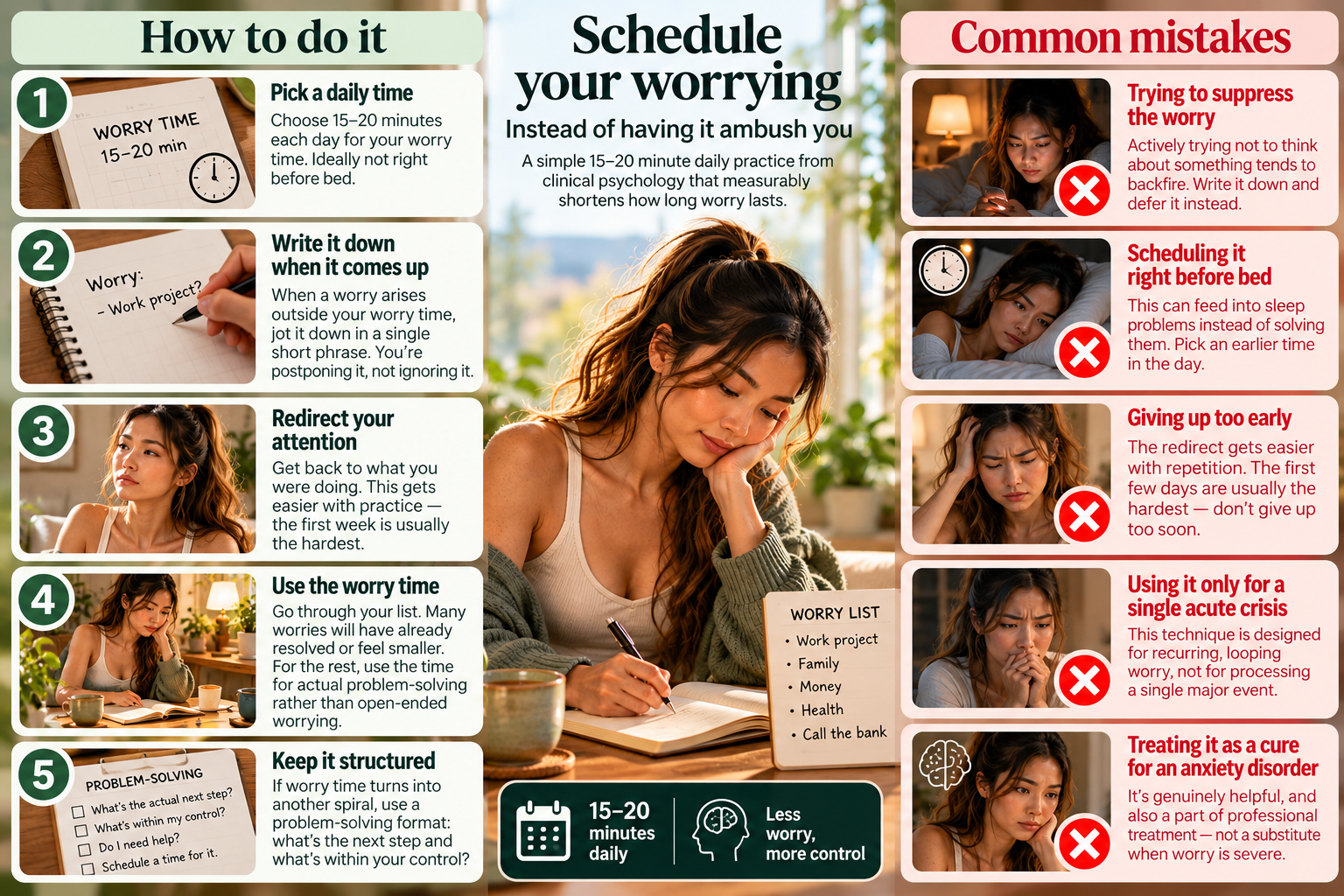
Schedule your worrying instead of having it ambush you
A 40-year-old technique from clinical psychology — postpone the worry to a set time instead of trying to stop it — measurably shortens how long worry actually lasts.

Before you try this. This technique is well-supported for everyday and moderate worry. If worry is severe, constant, or accompanied by panic, physical symptoms, or an inability to function, it belongs with a therapist rather than as a self-help technique alone — worry postponement is often used as one part of professional treatment for generalised anxiety, not a replacement for it.
One mindvestment
When a worry shows up outside your set worry time, note it in one line and deliberately postpone thinking about it until then
- Costs
- 15 min a day
- Effort
- Medium
- Gives you
- Less time spent worrying overall, and worries that feel more manageable when you do address them
- Felt after
- 1–2 weeks
Set a specific 15–20 minute “worry time” later in the day. When a worry shows up outside that window, write it down in a single line and deliberately postpone engaging with it until your worry time arrives. This sounds almost too simple to work — the research suggests it genuinely does.
Why this works
The technique dates back to Thomas Borkovec’s work in the early 1980s and is built on a straightforward idea: worry is a habit that gets triggered by cues — a thought, a notification, a quiet moment — and immediately, automatically engaged with. Postponement doesn’t try to suppress the worry or argue it away. It breaks the automatic link between the trigger and the immediate spiral, without asking you to never think about the thing at all.
Two things tend to happen once people actually try it, and both are part of why it works. First, a meaningful share of postponed worries lose their urgency by the time the scheduled worry period arrives — reviewed later and out of the moment, they often look smaller or more manageable than they felt at 11am. Second, and more counterintuitively, the technique directly challenges a belief that keeps worry cycles going: the sense that worry is uncontrollable. Successfully postponing it, even a few times, is direct evidence against that belief, which itself tends to reduce how compulsive worrying feels going forward.
A meta-analysis pooling the trials on this found a consistent, significant reduction in daily worry duration and associated physical complaints in the intervention groups compared to controls. It’s graded B rather than A because results are more mixed on the deeper mechanism — some studies find it shifts the beliefs about worry being uncontrollable, others don’t replicate that specific effect — even though the top-line finding, that it reduces how much time is spent worrying, holds up well.
How to do it
- Pick a consistent daily worry time — 15 to 20 minutes, ideally not right before bed, since that risks feeding into sleep problems instead of solving them.
- When a worry arises outside that window, write it down in a single short phrase. This is the postponement — you’re not ignoring it, you’re deferring it with a note as proof you’ll come back to it.
- Deliberately redirect attention back to whatever you were doing. This gets easier with practice; the first week is usually the hardest.
- During the scheduled worry time, go through the list. Some entries will have already resolved themselves or shrunk in importance. For the ones that haven’t, use the time for actual problem-solving rather than more unstructured worrying.
- If the worry time itself becomes just as spiralling as unscheduled worry, that’s a sign to bring a structured problem-solving format to it — what’s the actual next step, what’s within your control — rather than open-ended rumination.
Common mistakes
- Trying to suppress the worry instead of postponing it. Actively trying not to think about something tends to backfire; the note-and-defer step matters because it acknowledges the worry rather than fighting it.
- Scheduling worry time right before bed. This risks training the evening into a worry cue, working against separate sleep-related advice about winding down.
- Giving up after a few difficult days. The redirect gets easier with repetition — early difficulty isn’t a sign it’s not working.
- Using the technique for a single acute crisis rather than recurring worry. This is built for the repetitive, looping kind of worry, not for processing a single major event, which usually needs a different kind of support.
- Treating it as a cure for a diagnosable anxiety disorder used alone. It’s genuinely helpful, and it’s also a component of professional treatment, not a substitute for it when worry is severe.
What should change
Expect the total daily time spent worrying to measurably shorten within one to two weeks, and the intensity of individual worries to feel somewhat reduced by the time you actually address them. If nothing shifts after several weeks of consistent practice, or if worry remains constant and distressing regardless, that’s the point to involve a therapist rather than persisting with the technique alone.
Your next step
If worry specifically tends to show up as you’re trying to fall asleep or during a night-time wake-up, pairing this with the article on waking at 3am gives you a structured place to put those thoughts rather than lying there with them.
Sources (2)
- Effects of worry postponement on daily worry, meta-analysis Applied Psychology, Health and Well-Being 2023
- Worry postponement from the metacognitive perspective, randomized waitlist-controlled trial Journal of Behavior Therapy and Experimental Psychiatry 2023