The fastest way to calm down in under a minute
Two inhales through the nose, one long exhale through the mouth — a real Stanford trial found it beat box breathing and meditation for immediate stress relief.
One mindvestment
Do 3–5 rounds of a double inhale through the nose followed by a long exhale through the mouth when you notice acute stress
- Costs
- 1 min a day
- Effort
- Low
- Gives you
- A rapid drop in physiological arousal, usable in the moment stress actually hits
- Felt after
- Seconds to a minute for acute stress; cumulative mood benefit over a month of daily practice
Take two inhales through your nose — a full breath in, then a smaller second inhale on top of it without exhaling — followed by one long, slow exhale through your mouth. Repeat three to five times. This single technique, called cyclic sighing or the physiological sigh, has more direct trial evidence behind it than almost anything else in the stress-management space.
Why this works
A natural sigh is the body’s own reset button for the lungs — it’s an involuntary double-inhale reflex that reinflates tiny collapsed air sacs and briefly resets breathing rhythm. What’s newer is deliberately reproducing that pattern on purpose as a stress-management tool, and testing whether it actually works better than the alternatives.
In 2023, a Stanford team ran a proper randomized controlled trial comparing four approaches head to head: cyclic sighing, box breathing, a hyperventilation-with-retention technique, and mindfulness meditation, each practised for five minutes a day over a month by 108 volunteers. All four groups improved. But cyclic sighing produced the largest gains in mood and the clearest drop in resting breathing rate, and — notably — its advantage grew over the month rather than fading, unlike some techniques whose benefits plateau early.
The likely mechanism is the long exhale specifically. Extending the out-breath relative to the in-breath increases activity in the vagus nerve, which is the body’s main “calm down” signal to the heart, and the double inhale beforehand maximises lung volume so the following exhale can be as long and complete as possible. This is graded B rather than A because, while the trial is well-designed and published in a solid peer-reviewed journal, it’s still essentially one study — a genuinely important one, but the field benefits from replication before this earns the highest grade.
How to do it
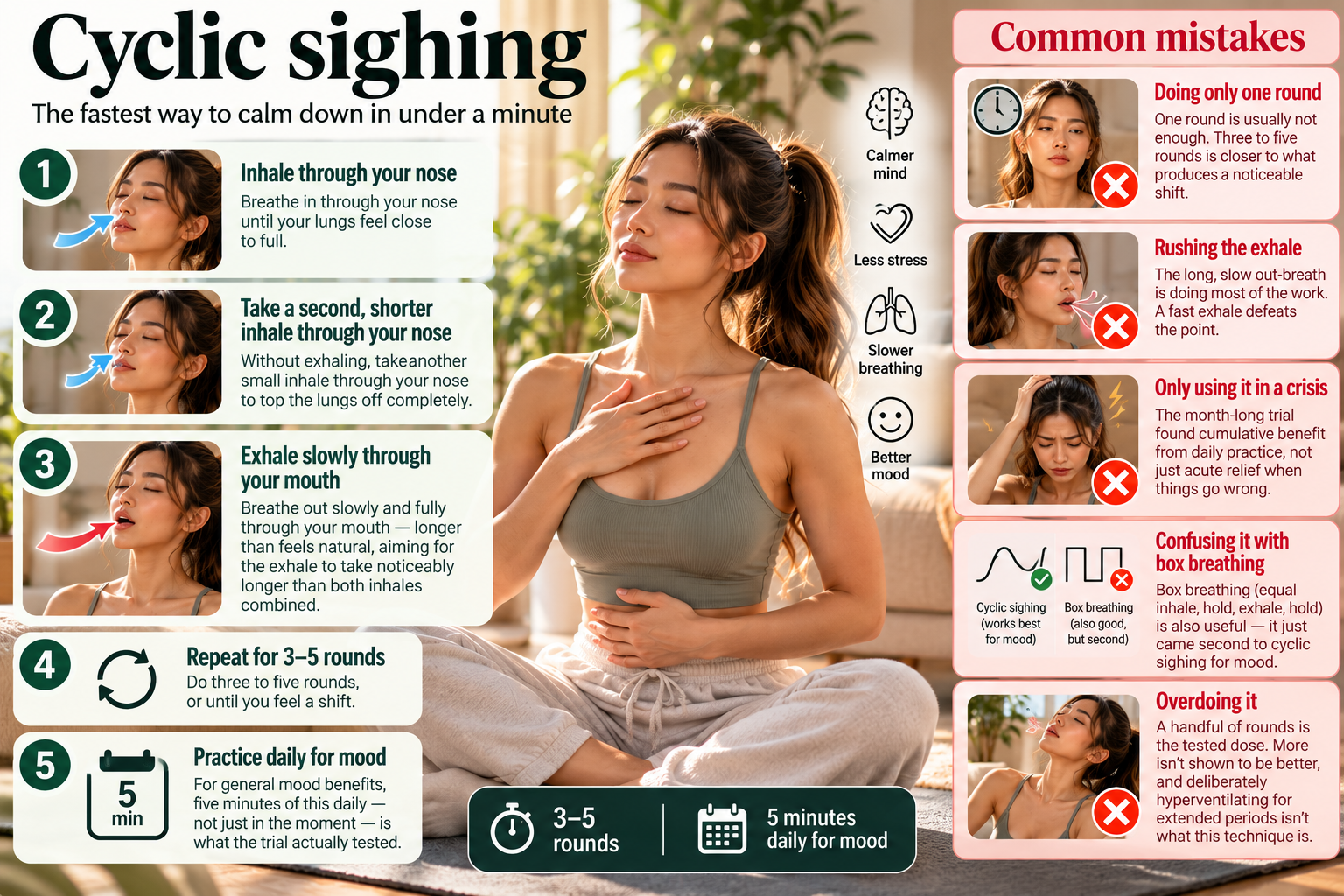
- Inhale through your nose until your lungs feel close to full.
- Without exhaling, take a second, shorter inhale through your nose to top the lungs off completely.
- Exhale slowly and fully through your mouth — longer than feels natural, aiming for the exhale to take noticeably longer than both inhales combined.
- Repeat for three to five rounds, or until you feel a shift.
- For general mood benefit rather than acute stress, five minutes of this daily — not just in the moment — is what the trial actually tested.
Common mistakes
- Doing one round and expecting a big effect. Three to five rounds is closer to what produces a noticeable shift.
- Rushing the exhale. The long, slow out-breath is doing most of the work — a fast exhale defeats the point.
- Only using it in a crisis. The month-long trial found cumulative benefit from daily practice, not just acute relief when things go wrong.
- Confusing it with box breathing. Box breathing (equal inhale, hold, exhale, hold) is also useful and was also tested in the same trial — it just came second to cyclic sighing specifically for mood.
- Overdoing it. A handful of rounds is the tested dose. More isn’t shown to be better, and hyperventilating deliberately for extended periods isn’t what this technique is.
What should change
In the moment, expect a noticeable drop in physical tension and racing thoughts within a minute or so of a few rounds — this is fast enough to use right before a difficult conversation or in the middle of a stressful moment. Used daily, expect a gradual improvement in overall mood and a lower resting breathing rate over the following weeks.
Your next step
If it’s not acute stress but recurring worry that’s the problem — the same anxious thought looping for hours — a breathing technique treats the symptom in the moment; worry postponement is the better-matched tool for the pattern itself.
Sources (2)
- Brief structured respiration practices enhance mood and reduce physiological arousal, randomized controlled trial Cell Reports Medicine 2023
- Dissecting cardiovascular responses to a fixed-interval volitional sighing protocol Psychophysiology 2025