Self-criticism doesn't actually motivate you better
The fear is that going easy on yourself kills your edge. The research points the other way — self-compassion predicts more sustained effort, not less.

One mindvestment
After a setback, deliberately say to yourself what you'd say to a friend in the same situation, instead of the harsher version you'd default to
- Costs
- 2 min a day
- Effort
- Low
- Gives you
- More sustained motivation after failure, and lower stress and anxiety day to day
- Felt after
- A shift in how setbacks feel within days; broader stress reduction over weeks
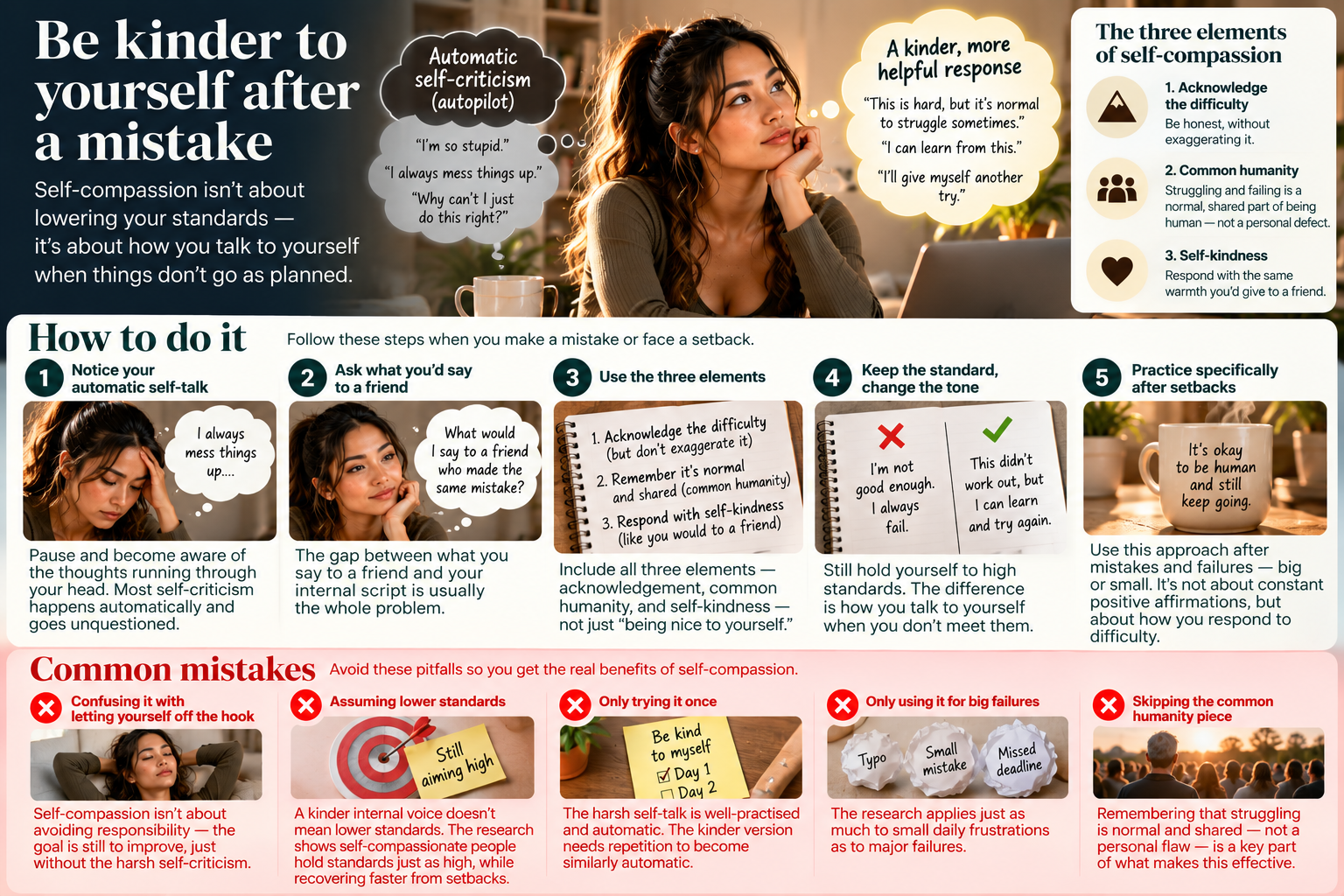
After a mistake or a setback, deliberately say to yourself something closer to what you’d say to a friend in the same spot — rather than the harsher internal commentary most people default to without noticing. This isn’t about lowering your standards. The research suggests it’s the more effective way to actually keep meeting them.
Why this works
The common fear is specific and understandable: if I stop being hard on myself, I’ll lose my edge, get complacent, stop pushing. It’s a reasonable worry, and it’s also the exact belief researchers have tested directly, repeatedly, against the alternative.
Self-criticism does work as a short-term motivator — that’s part of why people cling to it — but it works through a stress response, engaging the same physiological threat system triggered by external danger. That’s expensive to run continuously, and a substantial body of research links chronic self-criticism to higher rates of anxiety, depression, and burnout over time, not better long-term outcomes. Self-compassion, defined in the research as treating yourself with the same understanding you’d offer someone else, engages the parasympathetic system instead — genuine calm rather than threat-driven urgency — and studies find it’s associated with mastery-oriented motivation, wanting to improve because you care about the thing, rather than performance-oriented motivation driven by fear of falling short.
The self-efficacy connection is the part that most directly answers the “will I get soft” fear. A 2021 meta-analysis pooling around 60 studies found a consistent positive association between self-compassion and self-efficacy — the belief in your own ability to actually do the thing — with a medium effect size. People who treat their failures with more understanding aren’t shown to try less afterward; if anything, they’re more likely to try again, because the failure feels like useful information rather than a verdict on their worth.
This is graded B rather than A because most of the strongest evidence is correlational or based on Neff’s own well-validated self-compassion framework, rather than a large body of independent randomized trials proving the causal direction beyond doubt — the theoretical case and the consistency across studies are both strong, but the field would benefit from more experimental replication.
How to do it
- Notice the automatic self-talk after a mistake before you try to change it — most self-criticism runs on autopilot and goes unquestioned.
- Ask what you’d actually say to a friend who made the same mistake. The gap between that and your internal script is usually the whole problem.
- Include the three elements the research identifies as making this effective, not just “being nice to yourself”: acknowledging the difficulty without exaggerating it, remembering that struggling and failing is a normal, shared part of being human rather than a personal defect, and responding with the same warmth you’d extend to someone else.
- Keep the standard, change the tone. Self-compassion isn’t about lowering the bar — it’s about how you talk to yourself when you don’t clear it.
- Practice this specifically after setbacks, not as a constant background affirmation — the research is about how you respond to difficulty, not a general positivity habit.
Common mistakes
- Confusing self-compassion with letting yourself off the hook. The research explicitly separates this from self-indulgence — the goal is still to improve, just without the threat-based motivation.
- Assuming a softer internal voice means lower standards. The evidence points to self-compassionate people holding standards just as high, while recovering from missing them faster and more constructively.
- Only trying this once and concluding it “doesn’t work.” Like most self-talk patterns, the harsh version is well-practised and automatic; the kinder version needs repetition to become similarly automatic.
- Treating this as relevant only after big failures. The research applies just as much to small daily frustrations — a typo, a missed deadline, a bad conversation — where the automatic self-criticism often goes completely unnoticed.
- Skipping the “common humanity” piece. Reminding yourself that struggling is normal and shared, not a personal flaw, is part of what distinguishes this from generic positive self-talk.
What should change
Expect setbacks to feel less like verdicts on your worth within days of practising this deliberately, and a gradual reduction in general stress and self-criticism-driven anxiety over the following weeks. This isn’t about feeling instantly better after every mistake — it’s about the recovery being faster and the motivation to try again staying intact.
Your next step
If self-criticism tends to show up specifically as looping worry about a mistake rather than a single harsh comment, worry postponement is the more precisely matched tool for that pattern.
Sources (3)
- Self-compassion, theory, method, research, and intervention Annual Review of Psychology 2023
- Self-criticism and self-compassion, risk and resilience for psychopathology Current Psychiatry 2016
- Meta-analysis of self-compassion and self-efficacy Mindfulness 2021