It doesn't take 21 days to build a habit
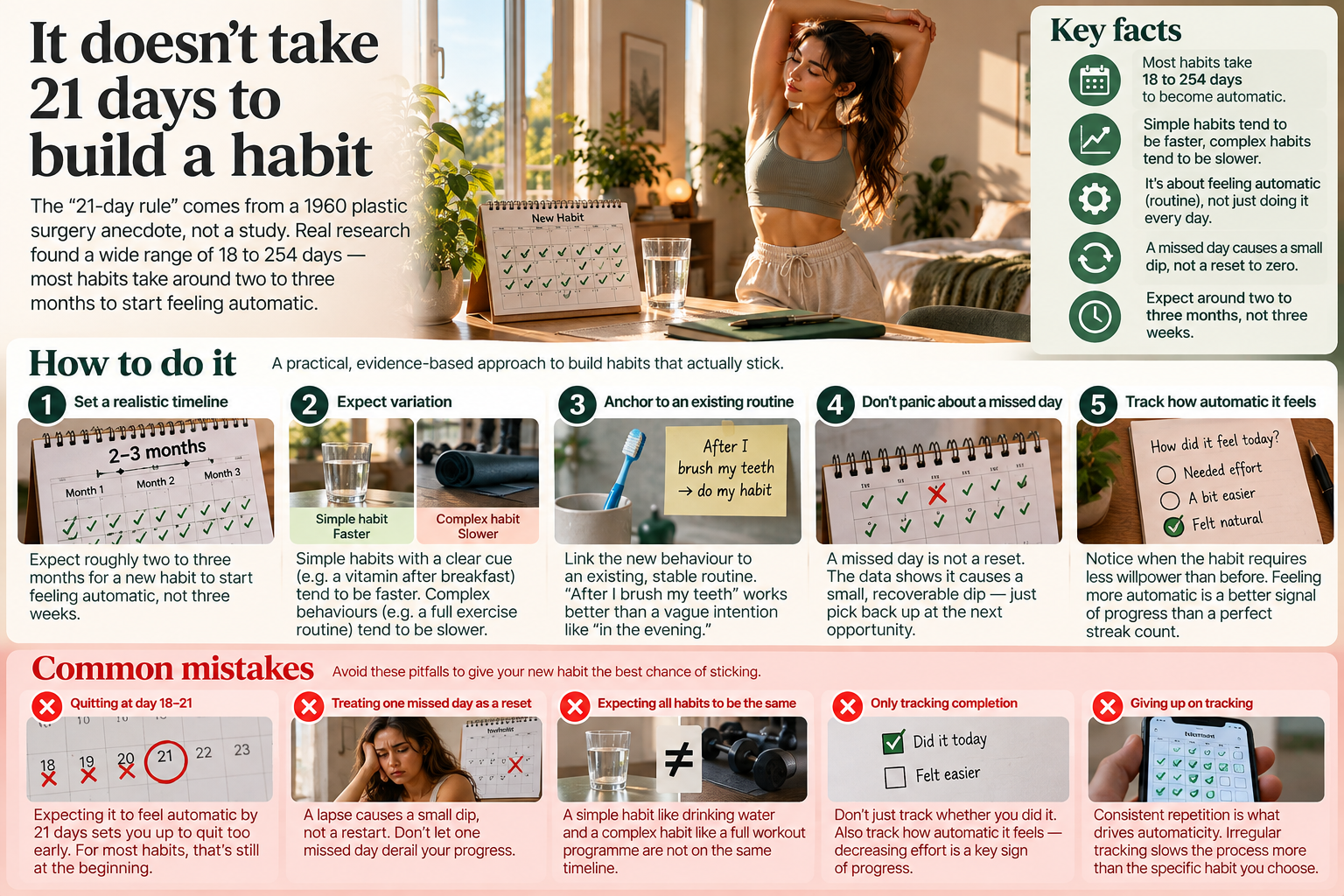
The 21-day rule comes from a 1960 plastic surgery anecdote, not a study. The real research found a range of 18 to 254 days — and that variation is the actual finding.

One mindvestment
Plan for 10–12 weeks of consistent repetition before a new habit feels automatic, not 21 days, and don't let one missed day feel like failure
- Costs
- 0 min a day
- Effort
- Low
- Gives you
- Realistic expectations that make you less likely to quit around week two or three, when most people give up
- Felt after
- The habit itself typically becomes automatic between 2 and 8 months, highly dependent on what it is
Expect somewhere around 10 to 12 weeks of consistent repetition before a new habit starts to feel automatic — not three weeks. And don’t treat one missed day as the habit falling apart; the research specifically found that it doesn’t.
Why this works
The “21 days” figure has no real study behind it. It traces back to a 1960 book by a plastic surgeon, Maxwell Maltz, who noticed patients took roughly three weeks to psychologically adjust to a changed appearance — an observation about adapting to a new face, not a finding about building a habit, that somehow became the most repeated statistic in self-improvement.
The actual research is both more useful and less tidy. In 2010, researchers at UCL tracked 96 volunteers who each chose a simple daily behaviour — eating a piece of fruit with lunch, doing 15 minutes of exercise — and measured how automatic it felt every day for 12 weeks. The average time to reach near-maximum automaticity was 66 days. But that average hides the actual finding: the range ran from 18 days for the fastest habit-formers up to 254 days for the slowest, a fourteen-fold difference. A larger 2024 systematic review pooling multiple studies since then found a similar picture — medians clustering around 59 to 66 days, means often higher, and individual variation stretching from a handful of days to nearly a year.
There’s a genuinely reassuring finding buried in the same data that rarely gets repeated alongside the headline number: missing a single day here and there didn’t meaningfully set back the process. Automaticity dipped slightly after a missed day but recovered on the next repetition — the habit-forming process turned out to be far more forgiving of an occasional lapse than the all-or-nothing framing around habits usually suggests.
How to do it
- Set your expectation at roughly two to three months, not three weeks, for a new habit to start feeling automatic rather than effortful.
- Expect variation by habit type. Simple additions with a clear cue — a vitamin after breakfast — tend toward the faster end. Complex behaviours with more decisions involved — a full exercise routine — tend toward the slower end.
- Anchor the new behaviour to an existing, stable routine rather than a vague intention. “After I brush my teeth” works better than “in the evening.”
- Don’t panic about a missed day. The data says it costs you less than it feels like it does in the moment — pick back up at the next opportunity rather than treating the streak as broken.
- Track how automatic something feels, not just whether you did it — noticing that a behaviour requires less willpower than it used to is a better signal of progress than a perfect streak count.
Common mistakes
- Quitting around day 18–21 because the “21-day rule” implied it should feel automatic by now and it doesn’t. For most habits, that’s actually still early — expecting automaticity this soon sets you up to quit right when it would otherwise be building.
- Treating one missed day as a reset to zero. The research specifically found this isn’t how it works; a lapse causes a small, recoverable dip, not a restart.
- Choosing an ambitious, complex habit and expecting it to move at the speed of a simple one. A full workout programme and drinking a glass of water after waking are not on the same timeline.
- Measuring success only by whether you did the behaviour, and never by whether it’s starting to feel easier. The feeling of decreasing effort is itself the signal that automaticity is developing.
- Giving up on tracking once it gets inconvenient. Consistency of the cue-behaviour link is what the data says drives the process; irregular repetition slows it down more than any specific behaviour choice does.
What should change
The specific behaviour should start requiring less conscious effort and fewer reminders somewhere in the two-to-four-month range for most everyday habits, with genuinely complex ones taking longer. If you’re past three months and something still feels entirely effortful every time, it’s worth checking whether the cue is consistent enough, rather than assuming the habit itself has failed.
Your next step
If the habit you’re building is a training routine specifically, pairing this realistic timeline with planned rest and lighter weeks matters — pushing through fatigue in month one to “build the habit faster” tends to backfire in exactly the way that article covers.
Sources (2)
- How are habits formed, modelling habit formation in the real world European Journal of Social Psychology 2010
- Time to form a habit, systematic review and meta-analysis of health behaviour habit formation Healthcare 2024