Why you feel foggy for ten minutes after every switch
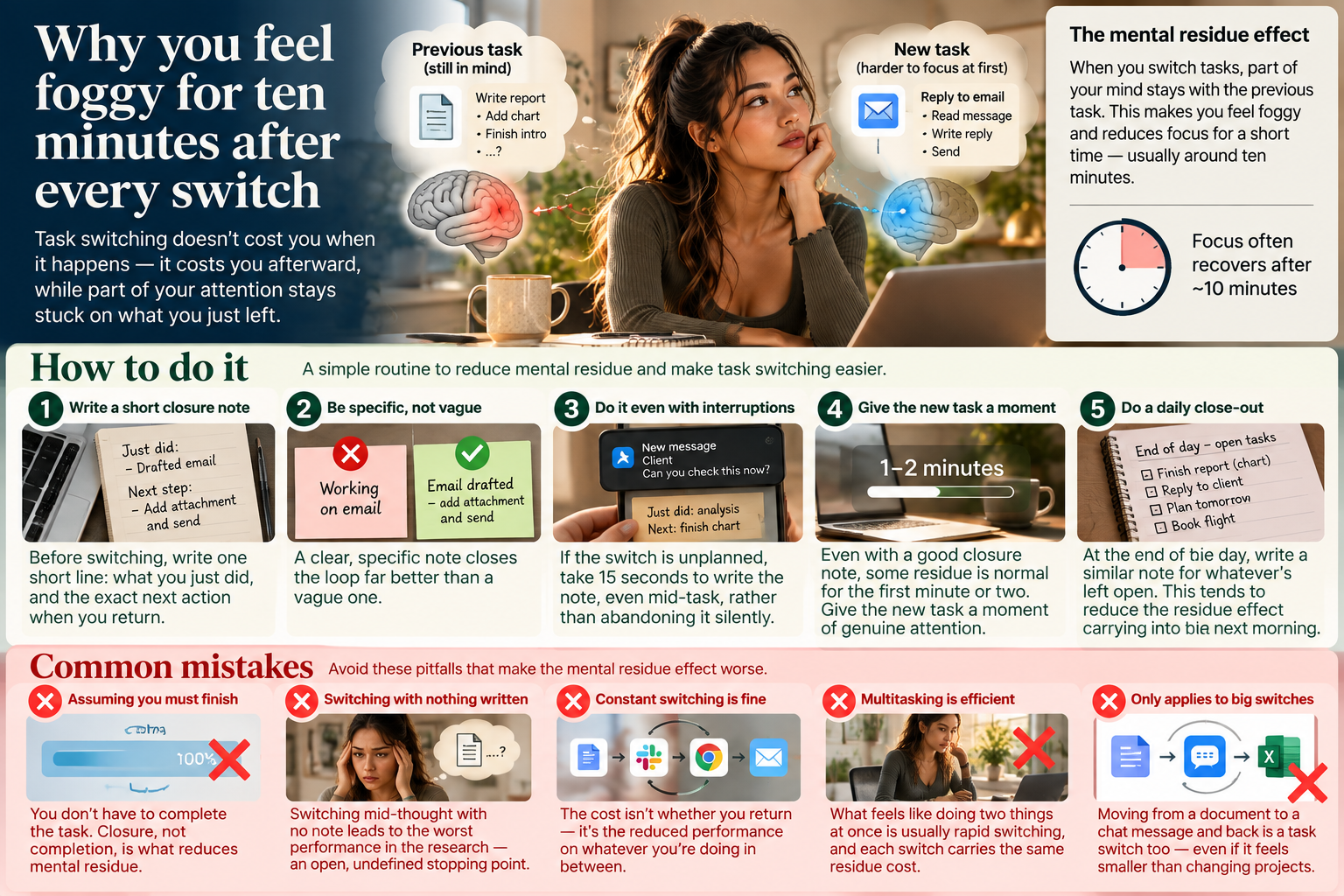
Task switching doesn't cost you when it happens — it costs you afterward, while part of your attention stays stuck on what you just left.

One mindvestment
Before switching tasks, write one line noting exactly where you stopped and what the next step is, rather than switching mid-thought
- Costs
- 1 min a day
- Effort
- Low
- Gives you
- Faster return to real focus after a switch, and fewer errors in the work done right after
- Felt after
- Immediate, per switch
Before you switch from one task to another, take fifteen seconds to write a single line: exactly where you stopped, and what the very next step will be when you come back. This small act of closure is what the research suggests actually reduces the mental fog that follows a switch — not the switch itself.
Why this works
The foggy, slightly-behind feeling you get for the first several minutes of a new task after leaving another one isn’t laziness or a lack of focus. Organizational psychologist Sophie Leroy documented this directly in a 2009 study: people who switched from an unfinished Task A to a new Task B performed measurably worse on Task B than people who’d completed Task A first — part of their attention was still, involuntarily, allocated to the thing they’d left behind. She named this attention residue.
The counterintuitive part of her finding is what actually predicted the size of the effect. It wasn’t simply whether Task A was finished. It was whether the person felt a sense of psychological closure on it — some participants who hadn’t technically completed Task A still performed well on Task B, because something (often, in the study, an external deadline forcing a decision) had given them a clear stopping point their mind could let go of. Task A left in a genuinely open, undecided state produced the worst residue, regardless of how much progress had actually been made.
This reframes the practical fix. You can’t always finish what you’re working on before you have to switch — meetings end, someone interrupts, the workday runs out. What you can usually do is manufacture the same sense of closure the “completed” participants got: a clear note of where things stand and what happens next, so your mind has something concrete to file the task under rather than an open question it keeps quietly chewing on in the background.
How to do it
- Before switching away from something unfinished, write one short line: what you just did, and the exact next action when you return.
- Be specific rather than vague — “email drafted, need to add the attachment and send” closes the loop far better than “working on email.”
- If the switch is unplanned (an interruption, an urgent message), take the fifteen seconds to do this even mid-task, rather than abandoning it silently.
- Give the new task a moment of genuine attention before expecting full focus — even with a good closure note, some residue is normal for the first minute or two.
- At the end of the day, a similar close-out note for whatever’s left open tends to reduce the same residue effect carrying into the next morning.
Common mistakes
- Assuming finishing is the only way to avoid residue. Closure, not completion, is what the research points to — a clear stopping point works even when the task itself isn’t done.
- Switching mid-thought with nothing written down. This is the condition that produced the worst performance in the original research — an open, undefined stopping point.
- Treating constant switching as fine because “I always come back to it.” The cost isn’t whether you return — it’s the degraded performance on whatever you’re doing in between.
- Multitasking and calling it efficient. What feels like doing two things at once is usually rapid switching, and each switch carries this same residue cost.
- Not applying this to digital switches. Moving from a document to a chat message and back is a task switch too, even though it feels smaller than changing projects.
What should change
Expect a noticeably faster return to real focus on the new task when you’ve left a clear closure note, compared with switching mid-thought — this is immediate and per-switch, not something that builds up over weeks. Over time, fewer scattered, half-remembered open loops should also mean less general background mental clutter.
Your next step
If task switching is happening because of external interruptions rather than your own choice to move on, that’s a different problem worth addressing directly — protecting blocks of uninterrupted time matters as much as how you handle the switches you can’t avoid.
Sources (2)
- Why is it hard to do my work, the challenge of attention residue when switching between work tasks Organizational Behavior and Human Decision Processes 2009
- Interruptions and cognitive performance, a review of the attention residue literature Journal of Applied Psychology 2021