The single most well-replicated fix for procrastination
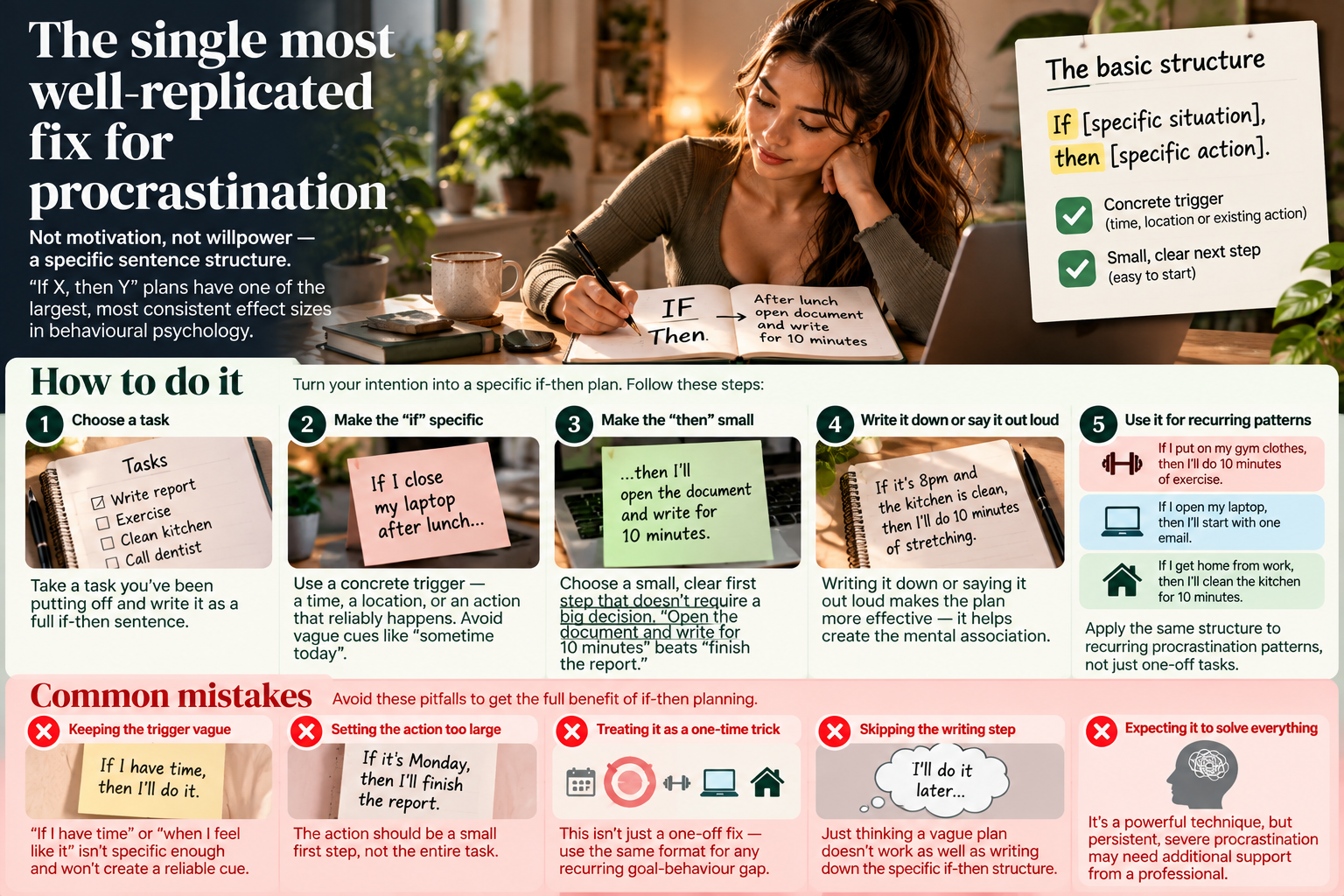
Not motivation, not willpower — a specific sentence structure. "If X, then Y" plans have one of the largest, most consistent effect sizes in behavioural psychology.

One mindvestment
Turn your next procrastinated task into a specific "if [situation], then I will [action]" plan, naming an exact time and place
- Costs
- 2 min a day
- Effort
- Low
- Gives you
- A meaningfully higher chance of actually starting, based on one of the largest effect sizes in applied psychology
- Felt after
- Immediate — this changes whether you start the very next time the situation arises
Instead of “I’ll work on the report tomorrow,” write “If it’s 9am and I’ve made coffee, then I will open the report and write for 25 minutes.” Same intention, radically different structure — and the structure is what a large body of research says actually matters.
Why this works
The technique is called an implementation intention, and it’s built on a specific, well-studied distinction: the gap between deciding to do something (a goal intention) and actually doing it isn’t usually a motivation problem — it’s a problem of the moment simply passing you by, because nothing concrete was triggering the action. A vague intention like “I’ll work on it” leaves you to notice the right moment, decide again, and act, all in real time, which is exactly where procrastination gets its foothold.
An implementation intention removes that gap by pre-deciding the trigger. Specifying an exact situation (“if it’s 9am and I’ve made coffee”) and linking it directly to an exact action (“then I will open the report”) creates an association strong enough that, in Gollwitzer’s own description, control of the behaviour effectively passes to the environment — when the cue shows up, the action follows with far less deliberate effort than starting from scratch would require.
The evidence behind this is unusually strong for behavioural psychology. A landmark meta-analysis pooling 94 independent studies and over 8,000 participants found an average effect size of Cohen’s d = 0.65 on goal attainment — a medium-to-large effect that, notably, didn’t shrink as more studies were added, a sign the finding is robust rather than a product of early, optimistic small trials. In the original demonstrations, difficult goals were completed roughly three times more often when people formed a specific if-then plan compared with just holding the intention. A more recent systematic review focused specifically on procrastination found implementation intentions among the more effective interventions tested for that exact problem.
How to do it
- Take a task you’ve been putting off and write it as a full if-then sentence: the specific situation first, the specific action second.
- Make the “if” as concrete as possible — a time, a location, or an action that reliably happens (“after I close my laptop from lunch”), not a vague window like “sometime today.”
- Make the “then” small enough that starting doesn’t require a big decision in the moment — “open the document and write for 10 minutes” beats “finish the report.”
- Write it down or say it out loud rather than just thinking it — the act of forming the specific plan is part of what creates the association, not just having the general intention.
- Use the same structure for recurring procrastination patterns, not just one-off tasks — “if it’s 8pm and the kitchen is clean, then I’ll do 10 minutes of stretching” works the same way as a work deadline.
Common mistakes
- Keeping the trigger vague. “If I have time” or “when I feel like it” isn’t a specific enough cue to create the automatic link the technique depends on — it just recreates the original problem in different words.
- Setting the action too large. The plan should specify the smallest concrete first step, not the whole task — “open the document” starts things moving; “finish the report” is still an intimidating goal intention wearing an if-then costume.
- Treating this as a one-time trick rather than a reusable structure. The same format applies to essentially any recurring goal-behaviour gap, from exercise to difficult conversations to financial tasks.
- Skipping the writing-down step. Thinking a vague version of the plan doesn’t reliably create the same effect as articulating the specific if-then structure.
- Assuming this fixes chronic, severe procrastination on its own. It’s genuinely one of the best-evidenced individual techniques, but persistent, distressing procrastination that resists this kind of structuring is worth discussing with a professional rather than assuming a planning trick alone will resolve it.
What should change
Expect a noticeably higher chance of actually starting the very next time the specified situation arises — this isn’t a habit that builds gradually, it’s closer to an immediate behavioural switch, which is part of why the effect size is as large and consistent as it is.
Your next step
If procrastination specifically shows up as bedtime avoidance — staying up later than you mean to — the same if-then structure pairs directly with the fixed-wake-time approach; “if it’s 10:30pm, then I turn off screens” is exactly this technique applied to a sleep habit.
Sources (3)
- Implementation intentions and effective goal pursuit Journal of Personality and Social Psychology 1997
- Implementation intentions, a meta-analytic review Advances in Experimental Social Psychology 2006
- Targeting procrastination using psychological treatments, systematic review and meta-analysis Frontiers in Psychology 2018