Mindfulness meditation, minus the enlightenment marketing
It has real evidence behind it, mostly for stress specifically. Much of its apparent advantage shrinks once you compare it against any other structured self-care activity.
One mindvestment
Try 10 minutes of guided breath-focused meditation daily for four weeks before deciding whether it's for you
- Costs
- 10 min a day
- Effort
- Low
- Gives you
- A measurable reduction in perceived stress for most people, with more modest and inconsistent effects on anxiety and mood
- Felt after
- 2–4 weeks of consistent practice
Try ten minutes of simple, guided breath-focused meditation daily for four weeks before deciding whether this is genuinely useful for you or not. The evidence is real, but it’s more specific and more modest than the wellness-industry version of the claim.
Why this works
Mindfulness-based stress reduction, the most studied structured meditation programme, has a genuinely solid evidence base for one thing in particular: stress. A meta-analysis of the programme in healthy, non-clinical people found a large effect on perceived stress, alongside moderate effects on anxiety, depression, and general distress. That’s a real, well-replicated finding, not a fringe claim.
Where the picture gets more complicated, and more honest, is what happens when studies compare meditation against something other than doing nothing. A meta-analysis in university students found a moderate overall effect on depression, anxiety, and stress compared with no intervention — but when compared against an active control condition, something else structured and supportive rather than a waitlist, that effect shrank dramatically, from a moderate effect down to something close to negligible. This is a genuinely important nuance: a meaningful share of meditation’s apparent benefit in weaker study designs may come from doing something deliberate and structured for your wellbeing, rather than from anything unique to the meditation technique itself.
For people already dealing with a diagnosed anxiety or depressive disorder, the picture splits further. A meta-analysis specifically restricted to people meeting diagnostic criteria found meaningful benefit for depressive symptoms, but the effect for anxiety symptoms specifically was less consistent, and — echoing the pattern above — benefits were clearer against inactive controls than against active ones. None of this means mindfulness doesn’t work. It means the honest version of the claim is narrower and more conditional than “meditation rewires your brain and fixes anxiety,” which is closer to how it’s often marketed.
How to do it
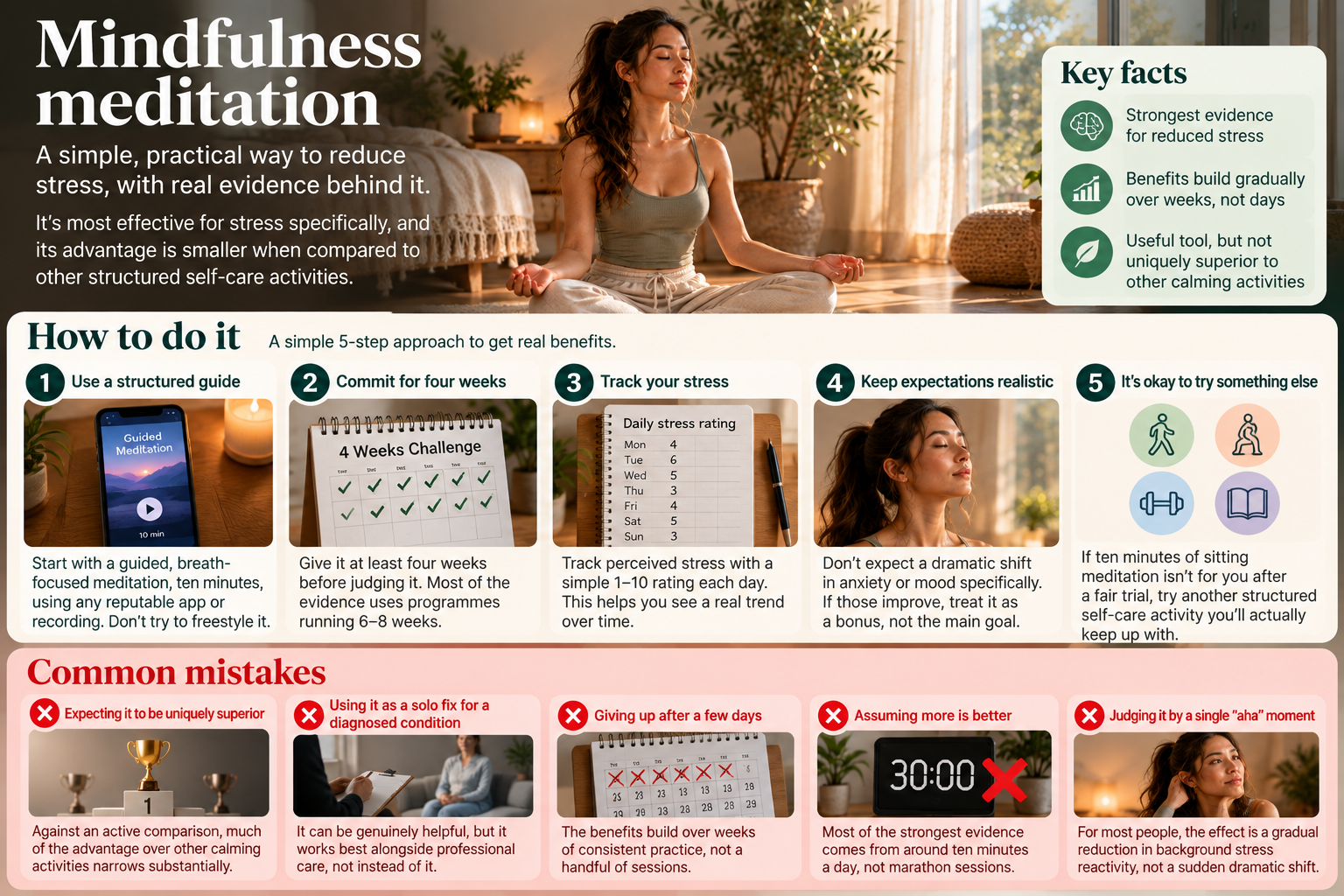
- Start with something structured rather than trying to freestyle it — a basic guided breath-focused meditation, ten minutes, using any reputable app or recording.
- Commit to four weeks before judging it. Most of the trial evidence uses programmes running six to eight weeks; four weeks is a reasonable minimum to notice something real.
- Track perceived stress specifically, since that’s where the evidence is strongest — a simple daily 1–10 rating is enough to notice a trend.
- Don’t expect a dramatic shift in anxiety or mood specifically. If those improve, treat it as a genuine bonus rather than the primary thing you’re testing for.
- If ten minutes of sitting meditation genuinely isn’t for you after a fair trial, that’s not a personal failure — the evidence suggests some of its benefit comes from structured self-care generally, and a different structured practice you’ll actually keep up with may serve the same function.
Common mistakes
- Expecting meditation to outperform any other calming activity based on the strongest headline statistics. Against an active comparison, much of that advantage narrows substantially — it’s a genuinely useful tool, not a uniquely superior one.
- Treating it as a fix for a diagnosed condition without other support. It shows real benefit, particularly for depressive symptoms, but the anxiety-specific evidence is more mixed, and it works best alongside professional care for a diagnosed condition, not instead of it.
- Giving up after a few days. The trial evidence is built on weeks of consistent practice, not a handful of sessions.
- Assuming more is automatically better. Most of the strongest evidence comes from roughly ten minutes a day over several weeks, not marathon sessions.
- Judging it by a single dramatic “aha” moment. For most people, the realistic effect is a gradual reduction in background stress reactivity, not a sudden shift.
What should change
Expect a noticeable reduction in how stressed day-to-day situations feel within two to four weeks of consistent practice — this is the effect with the strongest, most consistent evidence behind it. Anxiety and mood may also improve, but more modestly and less predictably, so treat those as a possible bonus rather than the main thing you’re testing.
Your next step
If acute, in-the-moment stress is more of the issue than general background stress, the physiological sigh is faster-acting and has more direct trial evidence for that specific use case than a daily meditation practice does.
Sources (3)
- Mindfulness-based stress reduction for healthy individuals, a meta-analysis Journal of Psychosomatic Research 2015
- Effects of meditation, yoga, and mindfulness on depression, anxiety, and stress in tertiary students, meta-analysis PLOS ONE 2019
- Mindfulness-based interventions for people diagnosed with a current episode of anxiety or depression, meta-analysis of RCTs Behaviour Research and Therapy 2014