The kind of journaling that actually helps
Not all journaling is equal. Writing that processes a difficult experience helps measurably. Writing that just replays it can make things worse.

Before you try this. This specific protocol isn't recommended for very recent trauma, or if you tend to go numb or feel overwhelmed rather than processing when you write about difficult things — for some people, and some experiences, this is better done with a therapist's support than alone.
One mindvestment
Write about a difficult experience for 15–20 minutes, focusing on your deepest thoughts and feelings about it, for three to four consecutive days
- Costs
- 20 min a day
- Effort
- Medium
- Gives you
- Reduced psychological distress and, in several studies, measurable physical health benefits
- Felt after
- Days to a few weeks
Write about something difficult for 15 to 20 minutes, focusing on your deepest thoughts and feelings about it rather than just recounting events, on three or four consecutive days. This specific format, developed by psychologist James Pennebaker in the 1980s, is one of the more extensively tested self-help techniques there is — over 200 studies since, with genuinely mixed but generally positive results.
Why this works
The core idea is that unprocessed difficult experiences take ongoing mental effort to keep suppressed or unexamined, and that effort has a cost — Pennebaker’s original research found that people who avoided thinking or talking about a traumatic event showed measurably worse physical health markers than those who processed it, even accounting for how severe the event itself was.
Writing about an experience in this specific way — not venting, not simply describing what happened, but exploring your deepest feelings and thoughts about it — appears to help people make sense of a chaotic experience by giving it narrative structure, which several studies link to reduced rumination and distress afterward. A major meta-analysis focused specifically on trauma-related outcomes found expressive writing produced meaningful reductions in post-traumatic stress symptoms and, in some studies, increases in post-traumatic growth.
The honest caveat, and the reason this is graded B rather than A: a widely cited meta-analysis of the broader literature found the average effect on mental health measures was real but modest — roughly a 5% improvement compared to control groups, larger for anxiety and PTSD symptoms, smaller for depression. And the benefit isn’t universal. Research on emotional expressiveness as a moderator found that people who are naturally low in emotional expressiveness sometimes saw anxiety increase rather than decrease after the exercise — for some people, this specific structured confrontation with difficult feelings isn’t the right tool, at least not without support.
There’s also an important distinction the research draws between this and simply venting or ruminating on paper. Writing that repeats the same distress without moving toward understanding or meaning tends not to produce the same benefit, and can reinforce rumination rather than resolve it — the “deepest thoughts and feelings” instruction is doing real work; it’s pushing toward processing, not just repetition.
How to do it
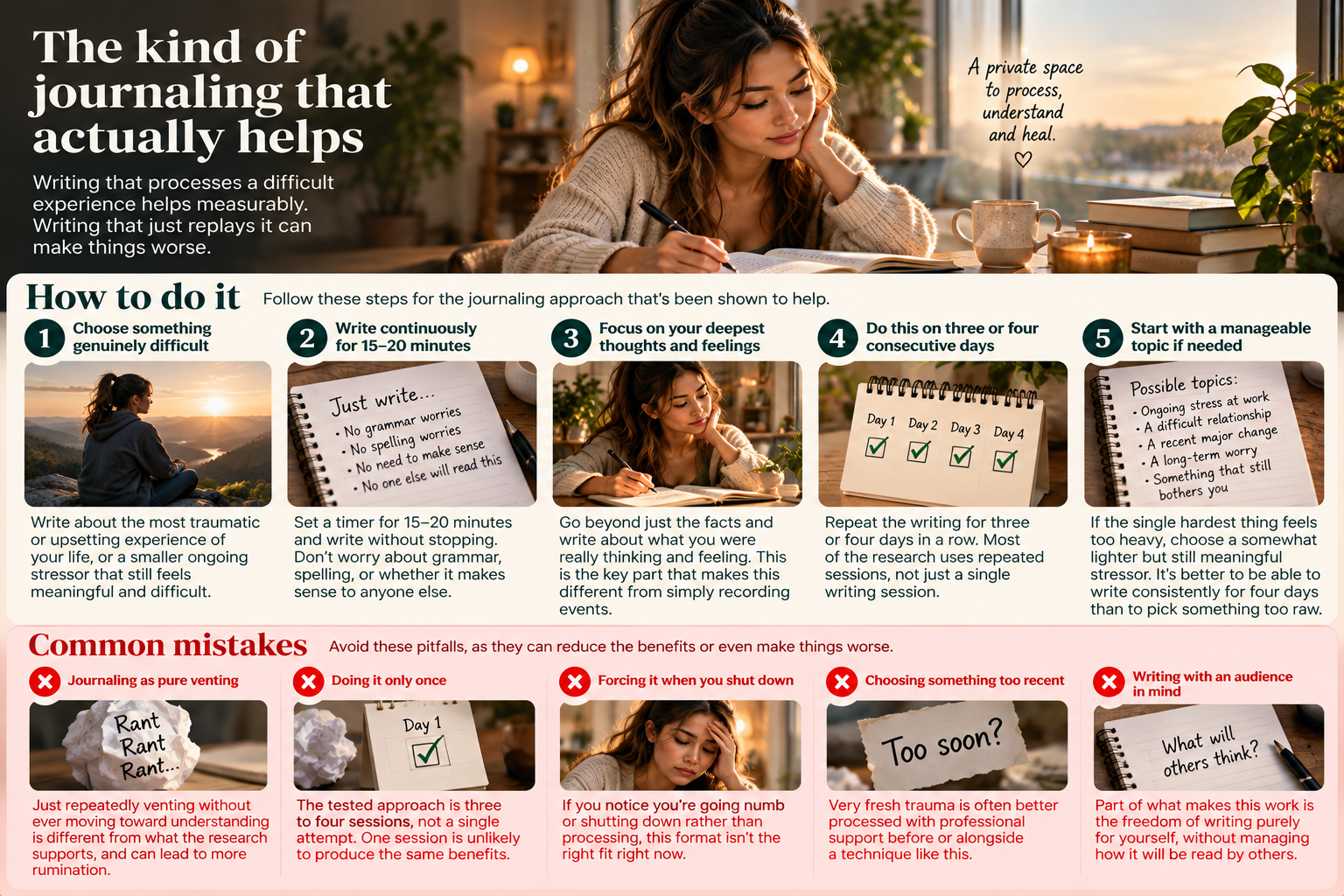
- Choose something genuinely difficult — Pennebaker’s original instruction was to write about the most traumatic or upsetting experience of your life, though smaller ongoing stressors work too.
- Write continuously for 15–20 minutes without worrying about grammar, spelling, or whether it makes sense to anyone else. No one else needs to read this.
- Focus on your deepest thoughts and feelings about the experience, not just a factual account of what happened — this is the part that distinguishes it from simply recording events.
- Do this on three or four consecutive days rather than once. The original protocol and most of the research testing it use repeated sessions, not a single writing session.
- If a single topic feels too heavy to sustain for four days, a somewhat lighter but still meaningful stressor is a reasonable place to start rather than the single hardest thing you can think of.
Common mistakes
- Journaling as pure venting, on repeat, without ever shifting toward understanding. This is a different activity from what the research supports, and the evidence on rumination-style writing is much less favourable.
- Doing it once and concluding it doesn’t work. The tested protocol is three to four sessions, not a single attempt.
- Forcing it if you notice you’re going numb or shutting down rather than processing. That’s a signal this particular format isn’t the right fit right now, not a sign you’re doing it wrong.
- Choosing something too recent or too raw. Very fresh trauma is often better processed with professional support before or alongside a technique like this.
- Sharing it or writing with an audience in mind. Part of what makes this work is the freedom of writing purely for yourself, without managing how it will be read.
What should change
Expect the specific experience you wrote about to feel somewhat less charged and more organised in your mind within the days following the sessions. Broader effects on mood and physical health markers, where studies find them, tend to show up over the following weeks rather than immediately.
Your next step
If what comes up while journaling turns out to be a specific looping worry rather than a processed, understood experience, worry postponement is a better-matched tool for that particular pattern than continued journaling on the same topic.
Sources (3)
- Expressive writing and its links to mental and physical health Oxford Handbook of Health Psychology 2014
- Meta-analysis of expressive writing on posttraumatic stress, growth, and quality of life Review of General Psychology 2019
- Effects of expressive writing on psychological and physical health, moderating role of emotional expressivity Journal of Research in Personality 2013