The "cold showers spike dopamine like cocaine" claim, checked
The 250% dopamine figure comes from one hour, neck-deep, in 60°F water — not a two-minute shower. The real effect is real, smaller, and shorter-lived than the popular version.
Before you try this. Cold water immersion carries real risks — cold shock response, which can affect breathing and heart rhythm, particularly in people with cardiovascular conditions. Build up gradually rather than starting with extreme cold, and anyone with a heart condition should check with a doctor before deliberate cold exposure.
One mindvestment
If you want an alertness boost, a brief cold shower is a reasonable, low-cost tool — just don't expect it to replicate the viral "250% dopamine" claim
- Costs
- 3 min a day
- Effort
- Medium
- Gives you
- A genuine, short-term lift in alertness and mood, with a realistic picture of how big and how long that effect actually is
- Felt after
- Immediate for alertness; no established evidence yet for lasting mood or depression treatment effects
If you enjoy cold showers and find they make you feel more alert, keep doing them — that part is genuinely supported. Just hold the “250% dopamine increase, comparable to cocaine” claim at arm’s length; it’s a real number from a real study, applied to a situation almost nobody doing a cold shower is actually replicating.
Why this works, and where the popular claim overreaches
The specific dopamine figure widely repeated in cold-exposure content traces back to one particular study: participants immersed in cool — not extremely cold — 60°F (about 15°C) water up to the neck, for roughly one hour. That’s the source of the large, sustained dopamine increase. A two-to-five-minute cold shower is a genuinely different exposure — shorter, often colder, and typically not full-body neck-deep immersion — and direct research on cold showers specifically is, by the field’s own admission, limited. Extrapolating a one-hour, neck-deep, 60°F immersion finding onto a two-minute home shower is a significant stretch, even though the direction of the effect (cold exposure increases arousal-related neurotransmitters) is real.
What’s better supported is more modest and more immediate. Studies using shorter cold-water immersion — a 2022 study used just five minutes at 20°C, noticeably milder than the dopamine-study conditions — found participants reported feeling more active, alert, and positive afterward, with corresponding changes in brain connectivity related to attention and emotional regulation. Norepinephrine increases from cold exposure are also well documented and occur faster than the more dramatic dopamine claims, plausibly explaining much of the alertness effect on its own.
The claims about cold exposure treating depression or anxiety are the part furthest ahead of the evidence. The most-cited paper proposing cold water as an antidepressant is explicitly a hypothesis paper, not a clinical trial, and as of the most recent search, researchers were still only at the protocol stage of running a proper systematic review and meta-analysis on cold-water exposure and mental health — meaning a rigorous synthesis of this evidence doesn’t yet exist. The field’s own assessment is that current evidence is “fragmented.” That’s a very different starting point than “proven mood treatment,” however compelling the individual case reports and small studies are.
How to do it
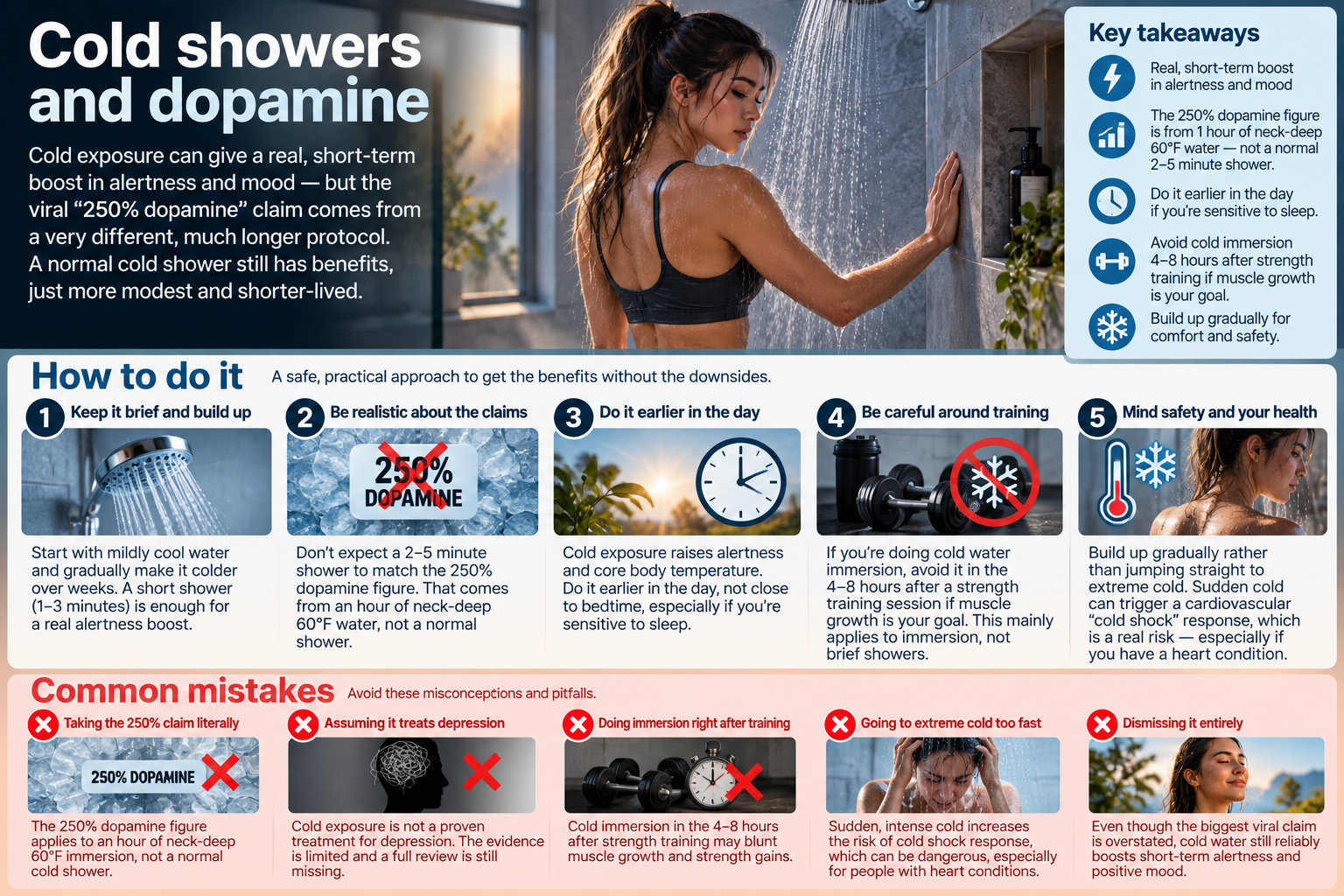
- If your goal is a short-term alertness boost, a brief cold shower — starting mild and building up over weeks — is a reasonable, low-risk tool with real support behind the immediate effect.
- Don’t expect a 2–5 minute shower to replicate the specific dopamine figures quoted in viral claims — those come from a much longer, colder, full-immersion protocol.
- Time it earlier in the day if you’re sensitive to sleep effects — cold exposure raises alertness and core body temperature afterward, which can work against winding down if done close to bedtime.
- If you’re using cold water immersion around strength training specifically, avoid it in the 4–8 hours after a session if muscle growth is your goal — research suggests it can blunt some training adaptations in that window, though this concern applies to immersion, not brief showers.
- Build up gradually rather than jumping straight to extreme cold — this matters for both comfort and the genuine cardiovascular risk of cold shock response.
Common mistakes
- Quoting the “250% dopamine, like cocaine” figure as if it applies to a normal cold shower. It describes an hour of neck-deep 60°F immersion — a substantially different exposure.
- Treating cold exposure as a proven depression treatment. The best current evidence is a hypothesis paper and scattered small studies, with a proper systematic review not yet completed.
- Doing extended cold water immersion right after strength training, expecting only benefits. For anyone training for muscle or strength gains, this specific timing may work against the adaptation you’re training for.
- Skipping the gradual build-up because “more intense must be better.” Sudden extreme cold carries real cardiovascular risk via the cold shock response, particularly for anyone with an underlying heart condition.
- Dismissing the practice entirely because the biggest claim about it is overstated. The more modest, better-supported finding — cold water reliably boosts short-term alertness and positive mood — is still a real, usable effect.
What should change
Expect a genuine, immediate lift in alertness and mood after cold exposure, most reliably documented in the minutes to hours afterward. Don’t expect this to function as an established treatment for depression or anxiety based on current evidence — that claim is running ahead of a completed evidence synthesis, not resting on one.
Your next step
If what you’re actually after is a fast, well-evidenced way to shift your state in the moment, the physiological sigh has more direct, controlled trial evidence behind it, and doesn’t require a cold shower or ice bath to access.
Sources (2)
- Short-term head-out whole-body cold-water immersion facilitates positive affect and brain network connectivity International Journal of Environmental Research and Public Health 2022
- Protocol for a systematic review and meta-analysis on the effects of cold-water exposure on mental health Systematic Reviews 2025