Zone 2 cardio isn't the mitochondria hack it's sold as
It's popular, accessible, and genuinely good for beginners. The specific claim that it's uniquely optimal for mitochondrial health doesn't hold up against the actual evidence.

One mindvestment
Use easy, conversational-pace cardio as your volume base, but add some genuinely higher-intensity effort if your actual goal is fitness or metabolic health, not just accessible activity
- Costs
- 30 min a day
- Effort
- Medium
- Gives you
- A more accurate picture of what different exercise intensities actually do, so you're not over-relying on the one the wellness industry is currently promoting
- Felt after
- Fitness changes build over 6–12 weeks regardless of which intensity approach you use
Use easy, conversational-pace cardio as a sustainable base you can do a lot of — that part of Zone 2’s reputation is earned. But if your actual goal is maximising mitochondrial adaptation or metabolic fitness rather than just building an exercise habit, the evidence doesn’t support Zone 2 as the uniquely optimal intensity it’s currently marketed as.
Why this works
Zone 2 — loosely, an intensity just below your first lactate threshold, roughly where you can hold a conversation but it takes some effort — became enormously popular in longevity and health circles on a specific claim: that this particular intensity is uniquely effective at building mitochondria and improving fat-burning capacity, more so than harder training. That claim traces back to real exercise physiology, but the popular version of it has outrun what a close look at the evidence actually supports.
A 2025 narrative review specifically examined this question and reached a pointed conclusion: current evidence does not support Zone 2 as the optimal intensity for improving mitochondrial capacity or fat oxidation. If anything, the review found the opposite — higher intensities tend to produce larger improvements in mitochondrial adaptations, capillary density, and cardiorespiratory fitness (VO2 max) than Zone 2 training does, particularly when training time is limited. The biological logic behind Zone 2’s marketing — low intensity relies more heavily on fat oxidation as a fuel source — is genuinely true. It just doesn’t follow, and the trial evidence doesn’t show, that training at that intensity therefore builds the underlying machinery better than harder efforts do.
What Zone 2 actually has going for it is more modest and, frankly, still valuable: it’s low-fatigue, sustainable, accessible to almost anyone regardless of fitness level, and allows a lot of weekly volume without much injury or burnout risk. For someone sedentary or new to structured exercise, it’s a genuinely good, low-barrier starting point. For an endurance athlete, it’s a useful tool for accumulating volume between harder key sessions. It’s the specific claim that it’s the optimal training zone for mitochondrial health in the general population that the evidence doesn’t back up.
How to do it
- If you’re new to exercise or returning after time off, easy conversational-pace cardio is a genuinely sound place to start — accessible and low risk, exactly as advertised.
- If you’re already reasonably fit and your goal is maximising cardiorespiratory or metabolic benefit, don’t rely on Zone 2 alone — the evidence favours including some genuinely higher-intensity work, not avoiding it in favour of an “optimal” low zone.
- A practical mixed approach most of the literature supports: the bulk of weekly cardio volume at an easy, sustainable pace, with one or two sessions a week at a harder, genuinely uncomfortable intensity.
- Don’t obsess over precise heart rate zones and lactate thresholds unless you’re training for competitive performance — “easy enough to talk, hard enough to notice” is a reasonable proxy for Zone 2 without lab testing.
- Judge Zone 2 by what it’s actually good for — sustainable volume, recovery-friendly activity, an accessible starting point — rather than by the mitochondrial optimisation claims currently attached to it.
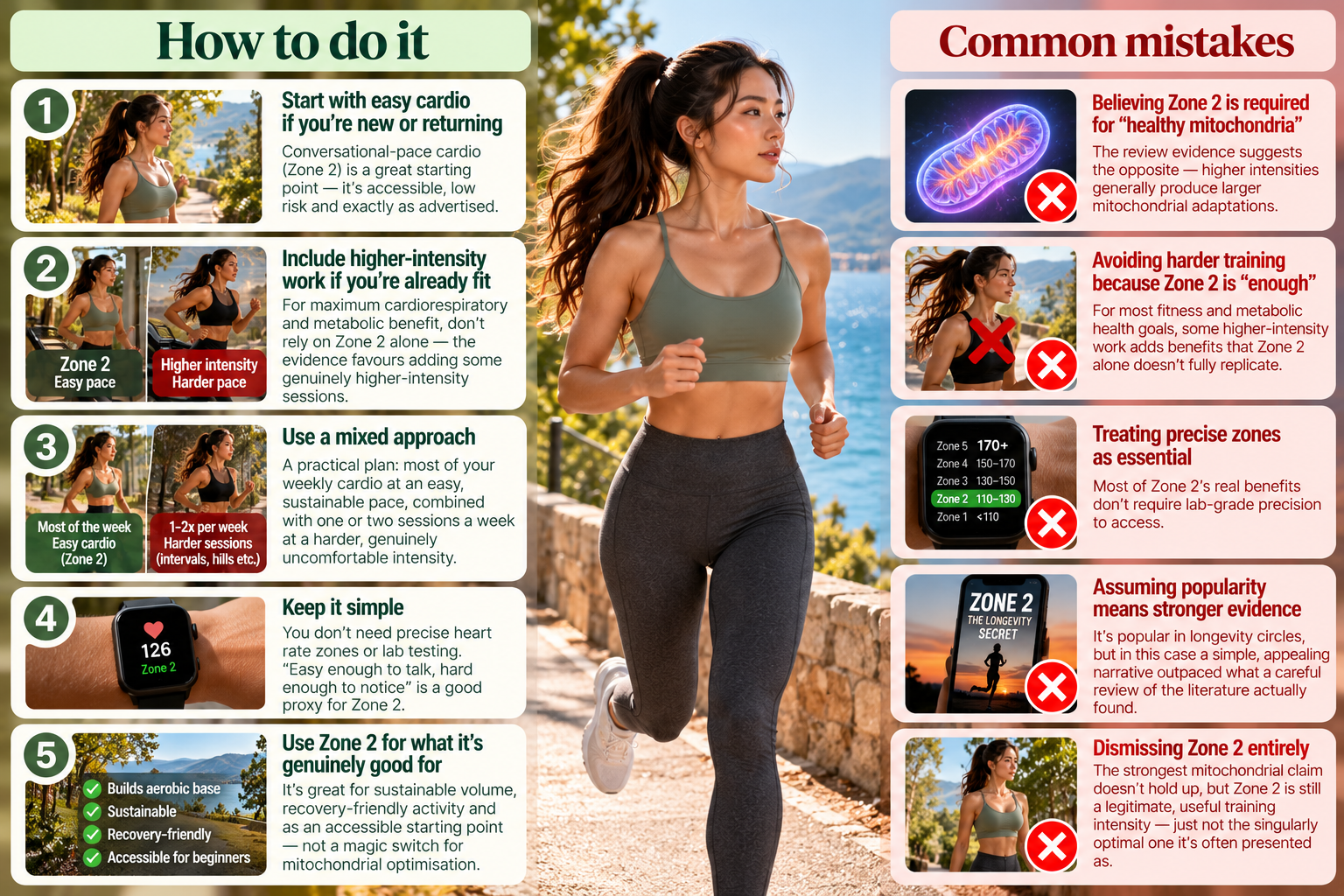
Common mistakes
- Believing Zone 2 is specifically required for “healthy mitochondria.” The review evidence points the other way — higher intensities generally produce larger mitochondrial adaptations.
- Avoiding harder training because Zone 2 is marketed as sufficient on its own. For most fitness and metabolic health goals, some higher-intensity work adds benefit Zone 2 alone doesn’t fully replicate.
- Treating precise zone calculation as essential. Most of Zone 2’s genuine benefit — sustainability, low fatigue, accessibility — doesn’t require lab-grade precision to access.
- Assuming “more popular in longevity circles” means “more rigorously tested.” This is a case where a simple, appealing narrative outpaced what a careful literature review actually found.
- Dismissing Zone 2 entirely because the strongest claim about it doesn’t hold up. It’s still a legitimate, useful training intensity — just not the singularly optimal one it’s often presented as.
What should change
Fitness improvements from either approach build gradually over six to twelve weeks of consistent training — this article is about which claims to trust, not about a faster timeline. If your goal is specifically mitochondrial or metabolic adaptation, expect somewhat better results from a mixed approach including higher intensity than from Zone 2 alone.
Your next step
If accessibility and sustainability are your actual priority right now rather than maximising physiological adaptation, the article on walking covers a similarly low-barrier, well-evidenced starting point without the mitochondrial framing to sort through.
Sources (2)
- Much ado about Zone 2, a narrative review assessing the efficacy of Zone 2 training for mitochondrial capacity Sports Medicine 2025
- Toward exercise guidelines for optimizing fat oxidation during exercise, systematic review and meta-regression Sports Medicine 2023