Two strength sessions a week is enough to start
You do not need a programme, a gym, or an hour. Five movements and twenty minutes, twice a week, covers most of what matters early on.
Before you try this. If you have a joint injury, a heart condition, or have not exercised in a long time, a brief check with a doctor before starting is a reasonable precaution, particularly for anything beyond bodyweight movement.
One mindvestment
Two 20-minute bodyweight strength sessions a week, covering five basic movement patterns
- Costs
- 20 min a day
- Effort
- Medium
- Gives you
- Noticeable strength within a month, meaningfully lower injury and frailty risk over years
- Felt after
- 2–4 weeks for noticeable strength
Two twenty-minute sessions a week, covering five basic movement patterns with just your bodyweight to start. No programme to follow yet — consistency at a small volume beats an ambitious plan abandoned in week three.
Why this works
The research on training frequency has a genuinely useful, slightly counterintuitive finding: for a beginner, two sessions a week produces close to the same strength gains as four or five, provided the total weekly effort is similar. The advantage of more frequent training only shows up at a more advanced level, where you need it to keep progressing at all. Early on, the limiting factor is not how often you train — it is whether you keep training at all, and a two-session commitment is dramatically easier to sustain than five.
The long-term case is separate from the short-term one and, if anything, stronger. Cohort studies tracking muscle-strengthening activity find a meaningfully lower risk of death from any cause among people doing some regular strength work, independent of how much cardio they also do. Strength training is also the single most effective tool for preventing the loss of muscle and bone density that accelerates from the late thirties onward — a process that is very hard to reverse later and comparatively easy to slow down early.
How to do it
The five patterns below cover most of what a body needs to do: push, pull, squat, hinge, and carry or hold. Two sessions a week, 3 sets of each, starting with bodyweight versions.
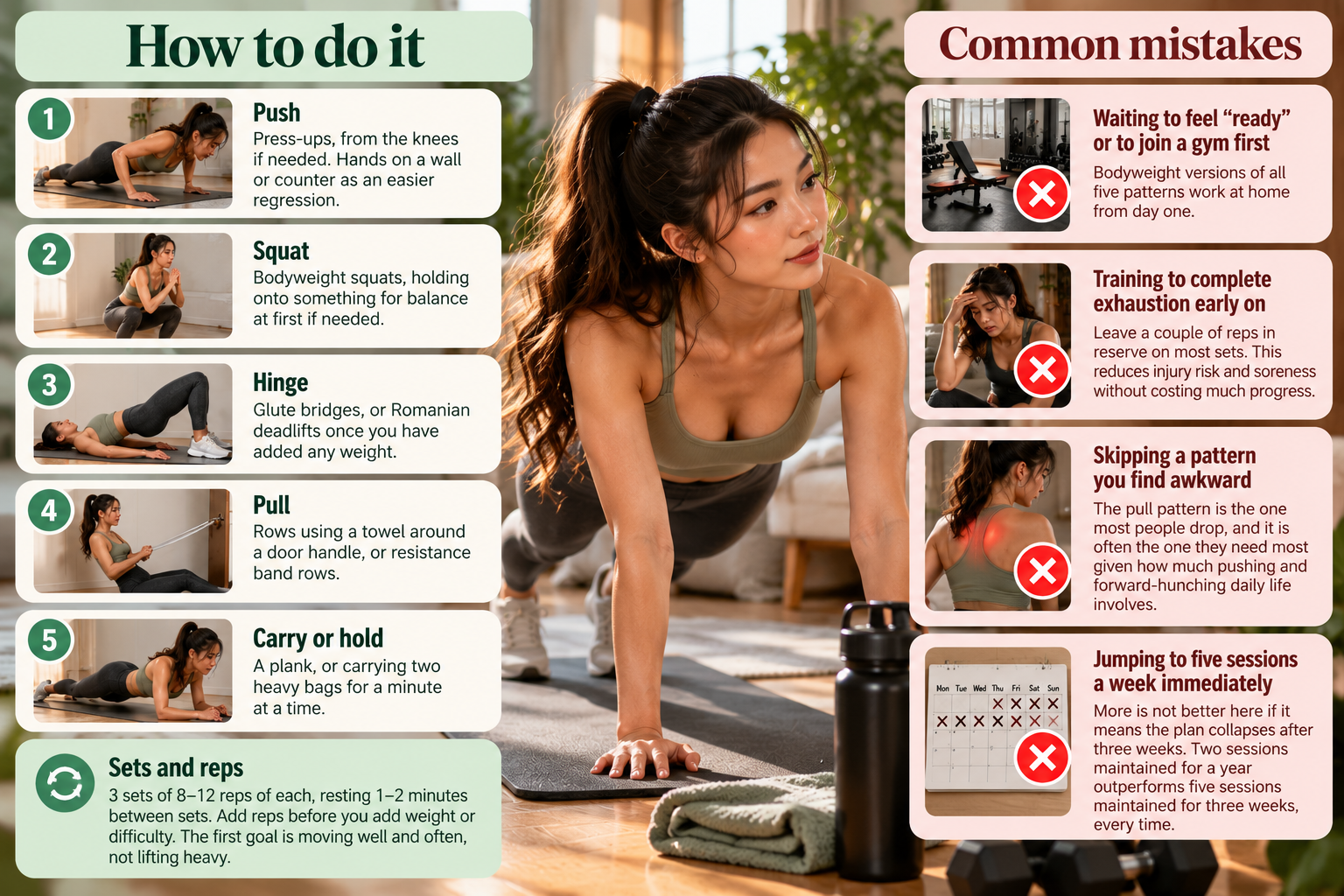
- Push — press-ups, from the knees if needed, hands on a wall or counter as an easier regression.
- Squat — bodyweight squats, holding onto something for balance at first if needed.
- Hinge — glute bridges, or Romanian deadlifts once you have added any weight.
- Pull — rows using a towel around a door handle, or resistance band rows.
- Carry or hold — a plank, or carrying two heavy bags for a minute at a time.
Start with 3 sets of 8–12 reps of each, resting a minute or two between sets. Add reps before you add weight or difficulty — the first goal is simply moving well and often, not lifting heavy.
Common mistakes
- Waiting to feel “ready” or to join a gym first. Bodyweight versions of all five patterns work at home from day one.
- Training to complete exhaustion early on. Leaving a couple of reps in reserve on most sets reduces injury risk and soreness without costing much progress, particularly in the first months.
- Skipping a pattern you find awkward. The pull pattern is the one most people quietly drop, and it is usually the one they need most given how much pushing and forward-hunching daily life already involves.
- Jumping to five sessions a week immediately. More is not better here if it means the plan collapses after three weeks. Two sessions maintained for a year outperforms five sessions maintained for three weeks, every time.
What should change
Expect noticeably easier reps and slightly more reps completed within two to four weeks — early strength gains are mostly a nervous system adapting to a new movement, not muscle growth yet, which is why they show up faster than people expect. Visible physical change takes longer and is a separate, slower process.
Your next step
Once bodyweight versions feel comfortably easy for 12–15 reps, adding load — a rucksack, resistance bands, or a gym visit — is the natural next step, at the same two-sessions-a-week frequency.
Sources (2)
- Resistance training frequency and strength gains, meta-analysis Sports Medicine 2016
- Muscle-strengthening activity and all-cause mortality, prospective cohort British Journal of Sports Medicine 2022