The truth about standing desks
They fix less than they're sold as fixing, and the thing that actually helps is easy to do without buying anything.
One mindvestment
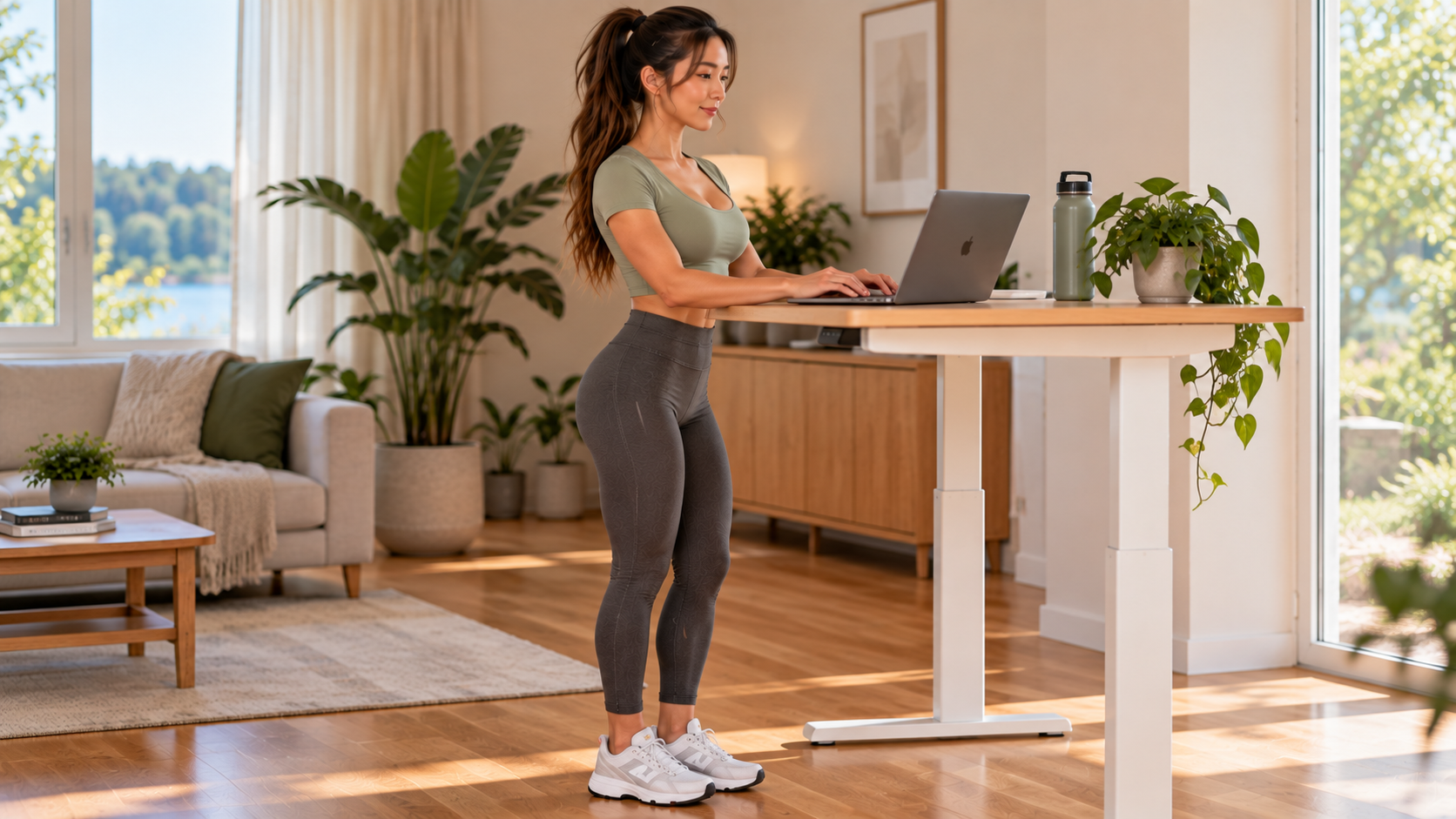
Alternate position roughly every 30–45 minutes rather than staying in one posture, standing or sitting, for hours
- Costs
- 0 min a day
- Effort
- Low
- Gives you
- Less accumulated stiffness and fatigue than either sitting or standing all day
- Felt after
- Same day
Change position roughly every 30 to 45 minutes rather than holding one posture, standing or sitting, for hours at a stretch. The standing desk isn’t the fix — the alternating is.
Why this works
A standing desk is sold as the antidote to sitting, but the research doesn’t really support “standing all day” as a solution any more than “sitting all day” is. Standing still for hours has its own costs — it loads the lower back and legs differently but no less continuously, and several studies find standing desk users report meaningful leg and lower-back discomfort within a few hours of continuous standing, a problem sitting doesn’t cause but standing does.
What the evidence more consistently supports is variation itself, not a specific posture. A systematic review of sit-stand interventions found that alternating position through the day reduced musculoskeletal discomfort more reliably than either fixed posture, and cohort research on total time spent sitting versus standing versus moving suggests it’s prolonged static time in any position, not sitting specifically, that tracks with worse outcomes. The body seems to tolerate almost any posture reasonably well in moderation and tolerates none of them well held for hours without a break.
This reframes the standing desk from a fix into one useful tool among several for achieving the same actual target: not staying still for long stretches, in whichever position.
How to do it
- If you already have a sit-stand desk, actually alternate on it — a desk left permanently raised is functionally the same mistake as a chair never left.
- Without a standing desk, a 30–45 minute timer to stand, stretch, or walk for a couple of minutes achieves most of the same benefit.
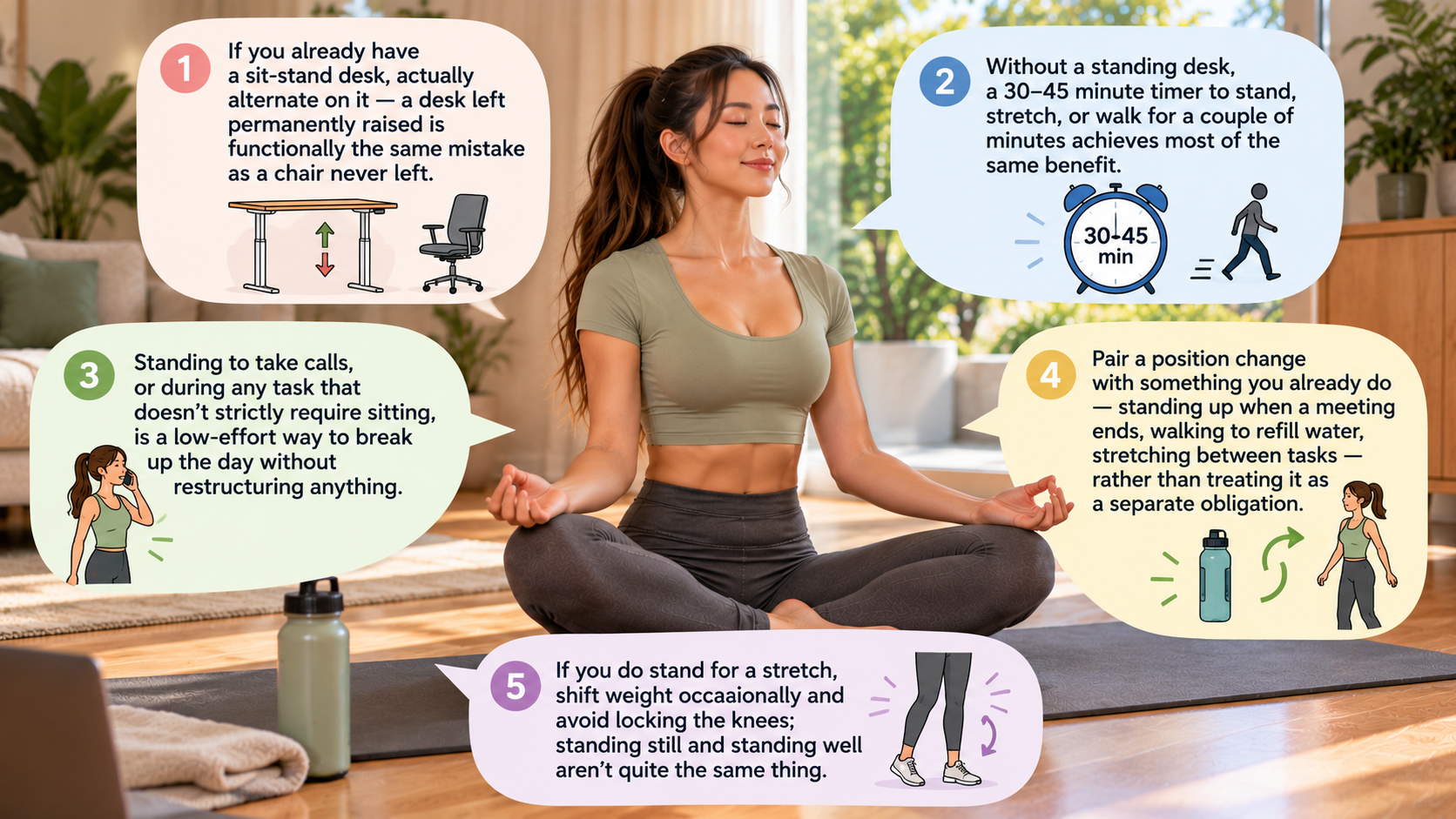
- Standing to take calls, or during any task that doesn’t strictly require sitting, is a low-effort way to break up the day without restructuring anything.
- Pair a position change with something you already do — standing up when a meeting ends, walking to refill water, stretching between tasks — rather than treating it as a separate obligation.
- If you do stand for a stretch, shift weight occasionally and avoid locking the knees; standing still and standing well aren’t quite the same thing.
Common mistakes
- Buying a standing desk and using it as a permanent standing desk. This trades one static-posture problem for a different one.
- Believing more standing straightforwardly means better health. The research doesn’t support a strong dose-response relationship for standing the way it does for daily movement and walking.
- Ignoring how the legs and lower back feel after long standing. Discomfort there is a real signal, not something to push through for the sake of “good posture.”
- Treating this as expensive to fix. A phone timer achieves most of what a sit-stand desk does, for anyone not ready to buy one.
- Forgetting that walking beats both. If the choice is between more standing or a short walk, the walk does more for circulation and energy either way.
What should change
Expect less accumulated stiffness and afternoon fatigue on days you alternate position regularly, noticeable the same day. This isn’t a change that needs weeks to show up — it’s closer to an immediate comfort difference than a slow physiological one.
Your next step
If the goal is genuinely more movement rather than just a different static posture, the short daily walks covered elsewhere do more for both energy and long-term health than any desk configuration alone.
Sources (2)
- Sit-stand desks and musculoskeletal discomfort, systematic review Applied Ergonomics 2020
- Occupational sitting and standing time and health outcomes, cohort study International Journal of Epidemiology 2018