Grip strength predicts how long you'll live better than blood pressure does
One of the most consistent findings in aging research — but the fix isn't a stress ball. It's a marker of total-body strength, not something to train in isolation.

One mindvestment
Don't train grip strength in isolation — let it improve as a natural side effect of the two-sessions-a-week strength routine, and treat a check of it as a rough gauge of whether that training is working
- Costs
- 0 min a day
- Effort
- Low
- Gives you
- A genuinely well-evidenced marker of overall muscular and physiological health, without a separate training protocol to maintain
- Felt after
- Improves gradually alongside overall strength training, typically noticeable over 2–3 months
Don’t buy a grip trainer or start squeezing a stress ball as a health intervention — that’s not what the research actually supports. Instead, let grip strength improve as a natural side effect of general strength training, and treat it as a rough, honest gauge of whether that training is actually working.
Why this works
Grip strength is one of the more remarkable findings in aging research, largely because of how consistently it shows up across very different, very large studies. The Prospective Urban Rural Epidemiology study followed over 140,000 adults across 17 countries and found that grip strength predicted all-cause mortality and cardiovascular events more strongly than systolic blood pressure — a genuinely striking result, given how much clinical attention blood pressure receives compared with a simple hand-squeeze test. A separate 17-year follow-up study found each standard-deviation reduction in grip strength associated with a 17% higher risk of death from any cause, a relationship that held up after adjusting for a wide range of other lifestyle and health factors and was consistent across age groups and both sexes.
The reason grip strength predicts so much isn’t magic in the hands themselves — it’s that grip strength is an efficient, easy-to-measure proxy for total-body muscle mass, neuromuscular function, and general physiological resilience. Weaker grip correlates with less muscle throughout the body, reduced cardiorespiratory fitness, and a body less equipped to recover from illness or injury — which is why it tracks so well with outcomes that have little to do with hands specifically, from cardiovascular disease to recovery from major illness.
This is exactly why the practical takeaway isn’t “train your grip.” A weak grip is a symptom of low overall muscle mass and strength, not an isolated deficiency that a stress ball fixes. Training general strength — the kind covered in the two-sessions-a-week approach elsewhere on this site — improves grip strength as a natural consequence, because carrying, pulling, and holding movements all use grip incidentally. Training grip in isolation without addressing overall strength misses the actual mechanism the research points to.
How to do it
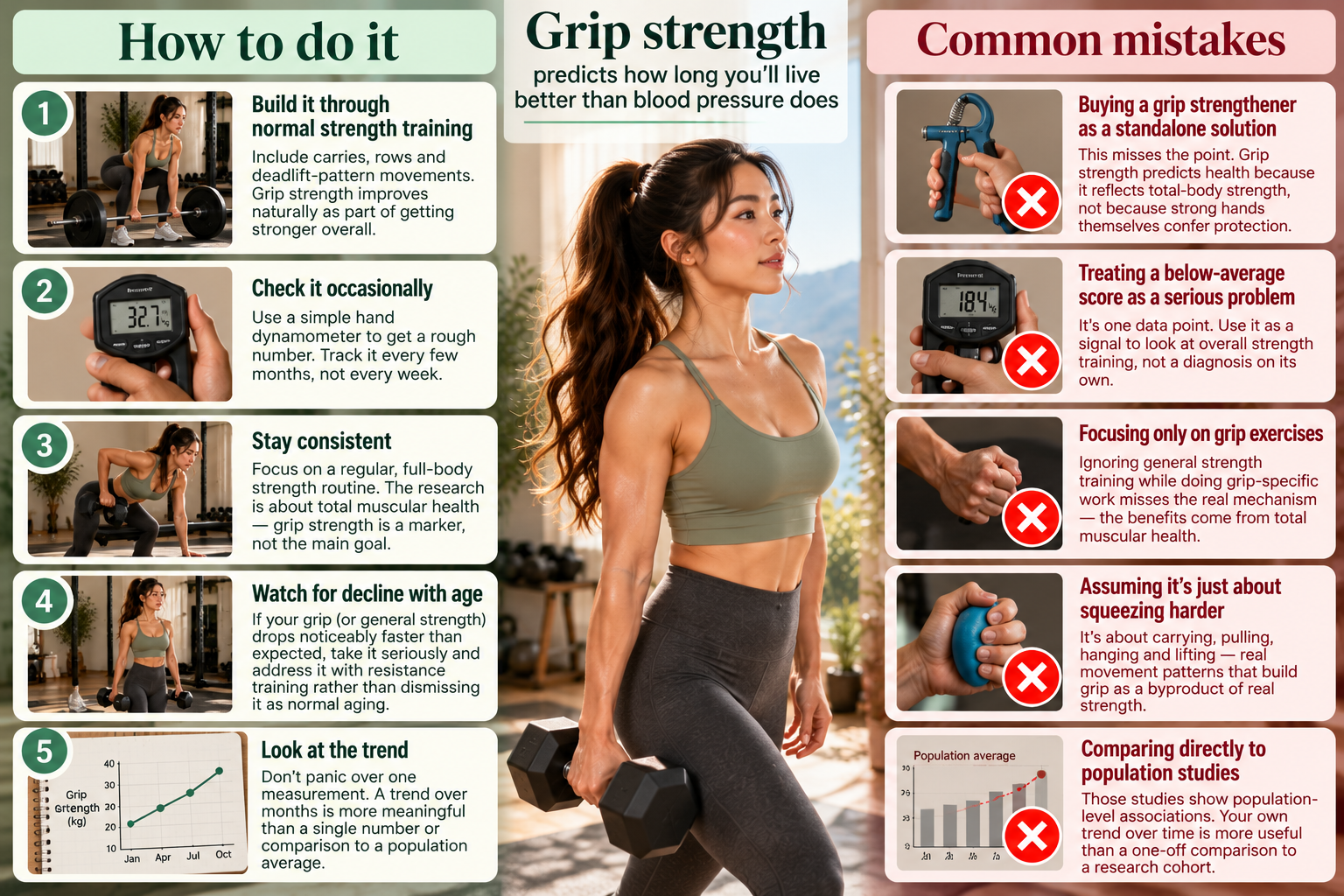
- Don’t add a separate grip-training routine — general strength training that includes carries, rows, and deadlift-pattern movements works grip naturally as part of the larger movement.
- If you want to check your grip strength as a rough marker, a simple hand dynamometer (inexpensive and widely available) gives you a number to track every few months, not something to obsess over weekly.
- Prioritise consistency in your overall strength routine over any grip-specific exercise — the research is about total muscular health, and grip strength is the messenger, not the message.
- Pay attention if grip strength (or general strength) declines noticeably with age faster than expected — this is exactly the pattern the research flags as worth addressing through resistance training rather than dismissing as normal aging.
- Don’t panic over a single measurement. Grip strength, like most physiological markers, is more meaningful as a trend over months than as a single number compared against a population average.
Common mistakes
- Buying a grip strengthener as a standalone health intervention. This misunderstands the mechanism — grip strength predicts health outcomes because it reflects total-body strength, not because strong hands themselves confer protection.
- Treating a below-average grip strength score as an alarming, isolated problem. It’s more useful as one data point suggesting a look at overall strength training, not a diagnosis on its own.
- Ignoring general strength training while focusing narrowly on grip. The causal story runs through total muscle mass and function — addressing grip specifically without the broader picture misses the point entirely.
- Assuming this is really about squeezing harder. It’s about carrying, pulling, hanging, and lifting — movement patterns that build grip as a byproduct of building real strength.
- Comparing your number directly to population studies without context. Those studies establish population-level associations; your own trend over time is more useful than a one-off comparison to a research cohort.
What should change
As overall strength improves through consistent training, expect grip strength to improve alongside it, typically noticeable over two to three months — the same timeline as general strength gains covered elsewhere. This isn’t a separate outcome to track on its own schedule; it moves with everything else.
Your next step
If you haven’t started a general strength routine yet, that’s the actual lever here — the two-sessions-a-week approach covers exactly the kind of training that improves grip strength as a natural consequence, without any grip-specific work required.
Sources (2)
- Prognostic value of grip strength, findings from the Prospective Urban Rural Epidemiology (PURE) study The Lancet 2015
- Grip strength from midlife onwards and all-cause and cause-specific mortality, 17-year follow-up BMJ Open 2016