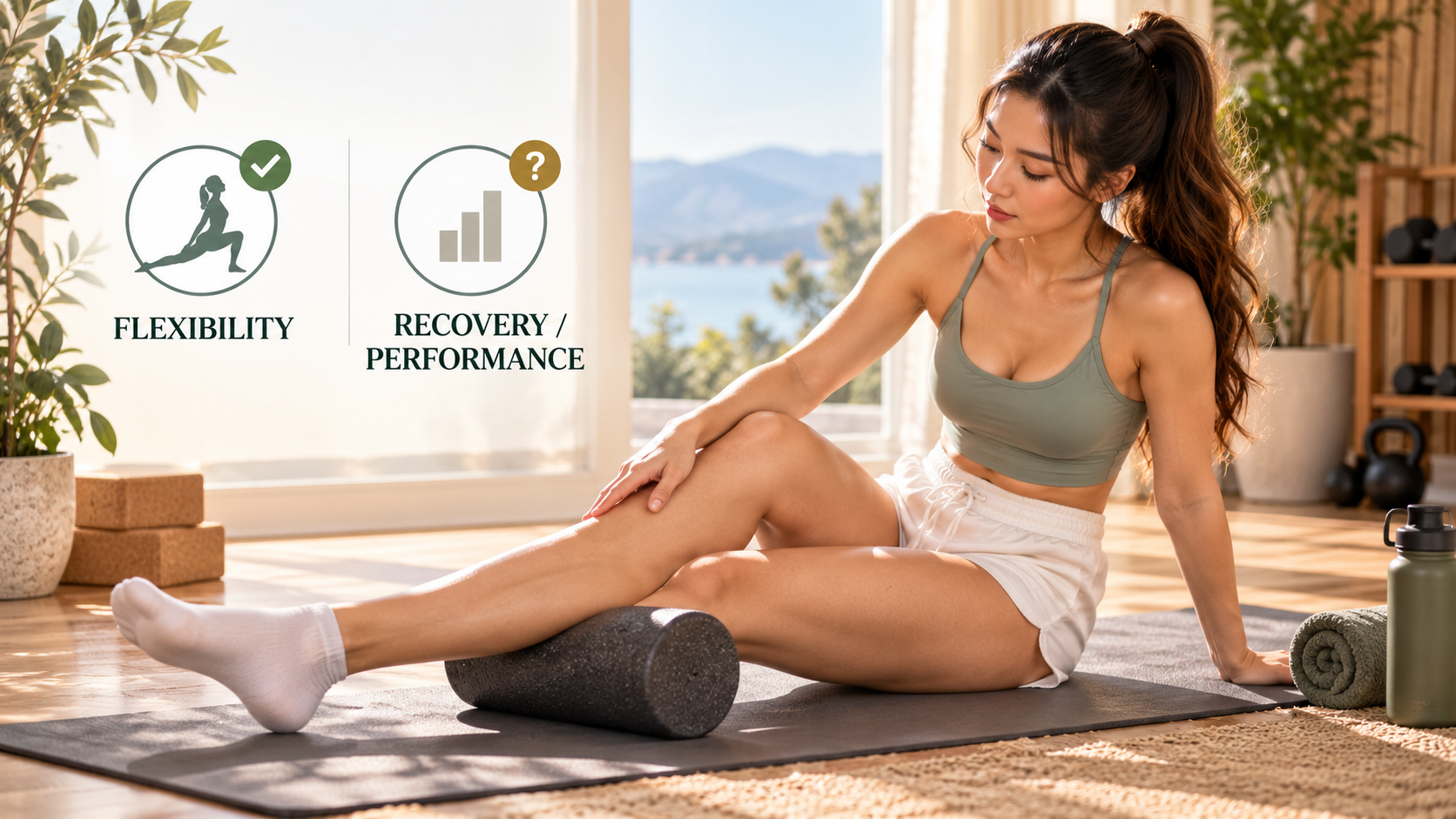
Foam rolling does one thing reliably. It's not what most people use it for.
The evidence for flexibility is genuinely good. The evidence for it as a recovery or performance tool is much thinner than the foam roller aisle suggests.
One mindvestment
Use foam rolling to improve flexibility and range of motion before training — don't rely on it as your main recovery or soreness-reduction tool
- Costs
- 10 min a day
- Effort
- Low
- Gives you
- Genuinely better range of motion without the performance cost of long static stretching
- Felt after
- Immediate for range of motion; minimal to inconsistent for soreness and recovery
Use a foam roller when you want more range of motion — before training, or as part of a mobility routine. Don’t rely on it as your primary tool for muscle soreness or recovery; the evidence for that specific use is considerably weaker than its popularity suggests.
Why this works, and where it doesn’t
Foam rolling — more formally, self-myofascial release — has been studied across dozens of trials, and one finding shows up consistently across nearly all of them: it reliably improves range of motion and flexibility, immediately, without the strength or power cost associated with long-duration static stretching. If the goal is simply “move through a fuller range right now,” foam rolling genuinely delivers that, and it does so safely across different roller types and body regions.
Where the evidence gets much thinner is everything else it’s commonly used for. On muscle soreness specifically, results are mixed at best — one study looking at recovery after high-intensity interval training described the effect on regaining lost performance as poor, while finding some potential benefit specifically for reducing the sensation of soreness, a more modest and narrower claim than “speeds up recovery.” Broader reviews attempting to assess foam rolling’s effect on performance find genuinely inconsistent results: some studies show a small positive effect on measures like speed, others find no effect at all, and a few even find a negative effect, depending on timing, technique, and what was measured. A systematic review looking specifically at joint range of motion, recovery, and performance concluded the evidence base, while suggestive of some benefit, still lacks the consistency needed for clear, confident recommendations on exactly how and when to use it.
None of this means foam rolling is useless — the flexibility effect alone is a real, well-replicated, low-risk benefit. It means the marketing built up around foam rollers as a comprehensive recovery and performance tool has outpaced what the actual research supports for anything beyond that one specific use.
How to do it
- Use foam rolling primarily as a flexibility and range-of-motion tool, most usefully before training on a muscle group you want to move through a fuller range.
- Keep expectations modest for soreness and recovery — it may help a little, based on limited evidence, but it isn’t a reliable substitute for the more consistently evidenced factors like sleep and gradual training progression.
- Roll slowly over a muscle group for 30–60 seconds per area rather than rushing, though there’s no single validated protocol the research has settled on as definitively optimal.
- Don’t roll directly over a joint, and ease off if you hit a genuinely painful spot rather than pushing through it — this is self-massage, not a technique that should hurt significantly.
- If you enjoy it and it feels good, keep using it — a real, low-risk flexibility benefit plus a pleasant sensation is a perfectly reasonable reason to include it, even without strong evidence for the bigger claims.
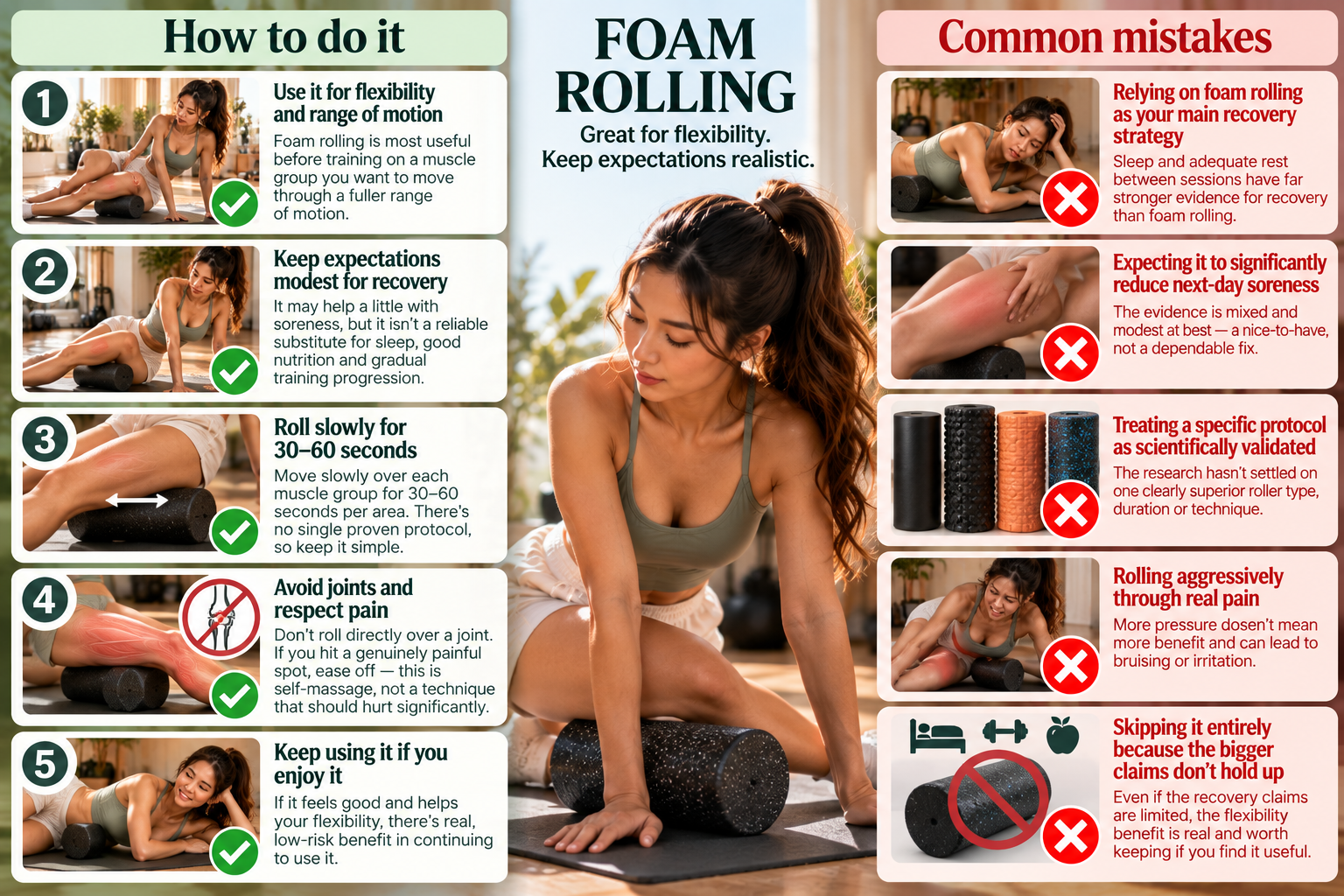
Common mistakes
- Relying on foam rolling as your main recovery strategy after hard training. Sleep and adequate rest between sessions have far stronger evidence behind them for that specific purpose.
- Expecting it to meaningfully reduce next-day soreness. The evidence here is mixed and modest at best — a nice-to-have, not a dependable fix.
- Treating a specific protocol (a certain number of minutes, a specific roller type) as scientifically validated. The research hasn’t converged on one clearly superior approach.
- Rolling aggressively through real pain, assuming more pressure means more benefit. This isn’t supported by the evidence and risks bruising or irritation.
- Skipping it entirely because the bigger recovery claims don’t hold up. The flexibility benefit alone is real and worth keeping if you find it useful.
What should change
Expect an immediate, noticeable improvement in range of motion right after rolling a muscle group — this is the most consistently supported effect. Don’t expect a similarly reliable change in next-day soreness or overall recovery; if you notice a benefit there, treat it as a personal bonus rather than something the evidence broadly promises.
Your next step
If reducing soreness after starting something new is the actual goal, gradual introduction of new movements has considerably stronger evidence behind it than any recovery tool applied afterward — worth reading the muscle soreness article for that angle instead.
Sources (3)
- Recovery effect of self-myofascial release treatment using different types of foam rollers Scientific Reports 2024
- A meta-analysis of the effects of foam rolling on performance and recovery Frontiers in Physiology 2019
- Self-myofascial release effect with foam rolling on recovery after high-intensity interval training Frontiers in Physiology 2019