Creatine is the most over-engineered simple supplement there is
25+ years of research, a genuinely strong effect on strength, and a safety record most supplements can't match. It's also routinely made to sound more complicated than it is.
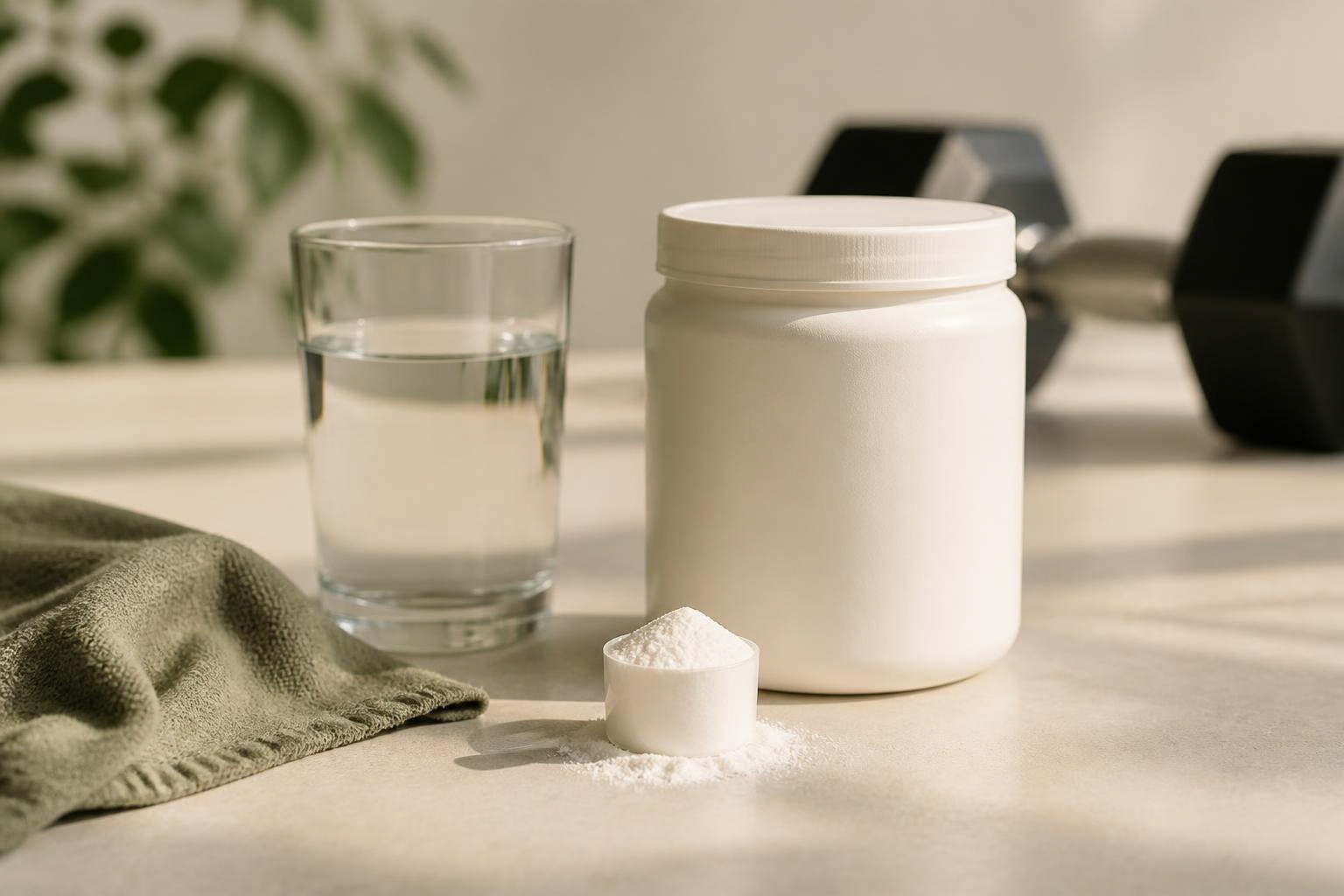
Before you try this. The American Academy of Pediatrics advises against creatine use in children and teenagers due to insufficient long-term safety research in that age group — this recommendation is for adults. If you have pre-existing kidney disease, check with a doctor first, though creatine has not been shown to harm normal kidney function in healthy adults.
One mindvestment
Take 3–5g of creatine monohydrate daily, any time of day, consistently — no loading phase or cycling required
- Costs
- 1 min a day
- Effort
- Low
- Gives you
- Measurably more strength and lean mass from the same training, with one of the best-established safety records of any supplement
- Felt after
- 2–4 weeks with a daily 3–5g dose; faster with an optional loading phase
Take 3 to 5 grams of plain creatine monohydrate daily, any time of day, and keep taking it consistently. No loading phase, no cycling on and off, no specific timing around workouts required — creatine is one of the most studied and most oversold-as-complicated supplements that exists.
Why this works
Creatine’s role in muscle energy production has been studied for over two decades, and the evidence for its core effect — increased strength, power, and lean muscle mass when combined with resistance training — is about as settled as sports nutrition science gets. A 25-year research summary from a leading sports science body describes it plainly: creatine monohydrate has not revealed adverse effects in clinical trials of healthy adults taking recommended doses, and there is, in their words, a mountain of literature demonstrating it increases muscle mass gained during training. Few supplements can claim both a large, consistent benefit and this length of safety track record simultaneously.
Two persistent myths are worth clearing up directly, because they’re common reasons people avoid it. Creatine does not cause dehydration or muscle cramping — research specifically testing this found no support for the claim, and one study of college football players actually found creatine users had less cramping and fewer signs of dehydration than non-users, likely because creatine increases water retention within muscle cells rather than depleting it elsewhere. And the popular loading protocol — a high dose for the first week — isn’t necessary; it saturates your muscle creatine stores faster, but a steady 3–5g daily dose reaches the same saturation point within about three to four weeks without it.
There’s a newer, genuinely interesting area of research beyond muscle: cognitive function. A 2024 meta-analysis found moderate-certainty evidence that creatine supplementation improves memory specifically, with lower-certainty evidence for processing speed and other cognitive domains — meaning real, but a less settled finding than the strength effect. The cognitive benefit also appears to be more pronounced under conditions that deplete brain creatine, such as sleep deprivation, and in older adults specifically, rather than being a large effect in a well-rested young adult at baseline.
How to do it
- Choose plain creatine monohydrate — it’s the most researched form, the cheapest, and no other form (creatine HCl, buffered creatine, and various branded versions) has been shown to outperform it despite frequently being marketed as superior.
- Take 3–5g daily, any time relative to training — the timing myths around “must be taken post-workout” aren’t well supported; consistency matters more than timing.
- Skip the loading phase unless you specifically want faster saturation — a steady daily dose gets you to the same place within three to four weeks.
- Take it with water and expect a modest amount of water retention within muscle cells — this is part of the mechanism, not a side effect to worry about, and isn’t the same as bloating.
- If you’re vegetarian or vegan, you may notice a larger relative benefit, since dietary creatine comes mainly from meat and fish, meaning your baseline muscle creatine stores are typically lower to start with.
Common mistakes
- Buying an expensive “advanced” form of creatine over plain monohydrate. The evidence base overwhelmingly sits behind monohydrate specifically; newer forms are marketed on theoretical advantages that haven’t been shown to matter in practice.
- Cycling on and off it. There’s no evidence this is necessary, and it just interrupts the saturation creatine needs time to build.
- Avoiding it out of dehydration or kidney concerns without a specific pre-existing condition. For healthy adults, the research specifically contradicts both worries at recommended doses.
- Giving it to a teenager without a doctor’s input. This is the one population where the safety data genuinely isn’t there yet, and professional guidance specifically flags it.
- Expecting a noticeable effect within days. Full muscle saturation without loading takes three to four weeks — this is a supplement for consistent, ongoing use, not a short-term experiment.
What should change
With consistent daily use alongside resistance training, expect measurably better strength and lean mass gains over the following weeks compared with training alone — this is where the strongest, most consistent evidence sits. Any cognitive benefit is a slower-building, more modest bonus rather than the primary reason to take it.
Your next step
Creatine’s benefit is specifically amplified by resistance training — pairing it with the two-sessions-a-week strength approach covered elsewhere is where the two compound rather than either alone.
Sources (2)
- Safety and efficacy of creatine monohydrate supplementation, what we've learned from 25 years of research Gatorade Sports Science Institute, Sports Science Exchange 2025
- The effects of creatine supplementation on cognitive function in adults, systematic review and meta-analysis Frontiers in Nutrition 2024